
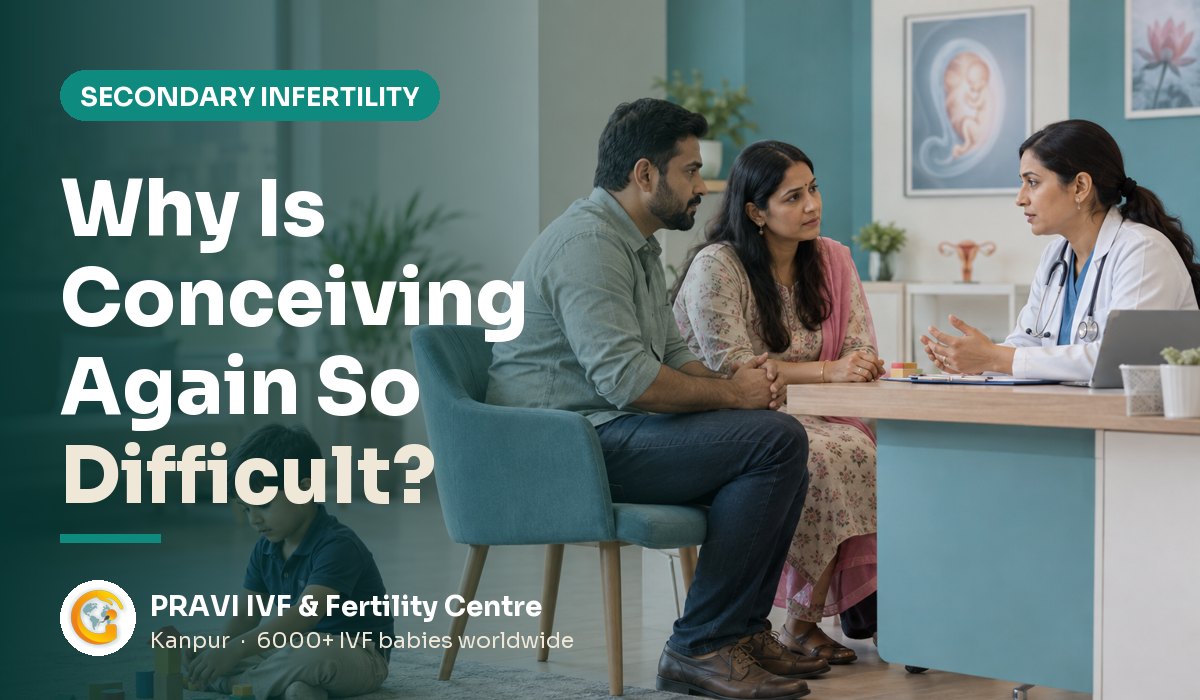
Secondary Infertility Treatment in Kanpur
Medically reviewed by Dr. Sakshi Tandon · Updated 12 Oct 2026
Secondary infertility catches many growing families off guard. Learn why conceiving a second baby can be difficult, how common causes are diagnosed, and what treatment options are available in Kanpur.
Bringing your first child into the world felt like pure magic. Maybe you conceived without any medical help, or perhaps it happened quickly. Now, a few years have passed, and you feel ready to grow your family. You dream of giving your toddler a sibling to play with, share secrets with, and grow alongside. But month after month passes, and that second pregnancy test stays stubbornly negative.
You might hear relatives at family gatherings in Kanpur casually ask, "Ek aur kab la rahe ho?" (When are you having the next one?). You smile on the outside, but inside, your heart sinks. You wonder how this can happen when you have already given birth once. If this sounds like your life right now, you are dealing with something called secondary infertility. At PRAVI IVF & Fertility Centre, we meet couples every week who face this exact struggle. Seeking Secondary Infertility Treatment in Kanpur is far more common than you might think, and you do not have to walk this confusing path alone.
What Exactly Is Secondary Infertility?
Secondary infertility is defined as the inability to conceive or carry a pregnancy to full term after having previously given birth naturally or through medical assistance. According to the World Health Organization, infertility affects millions of people globally, and a substantial portion of these cases involve secondary infertility.
Doctors generally diagnose secondary infertility when a woman under 35 has been having regular, unprotected intercourse for 12 months without getting pregnant. If you are 35 or older, we recommend seeking medical advice after just 6 months of trying. Because you already have a baby at home, it is easy to assume that everything is fine and you just need more time. However, our bodies go through significant changes over the years. Waiting too long can sometimes delay simple treatments that could help you complete your family.
The Silent Emotional Weight of Secondary Infertility
Secondary infertility carries a very specific type of emotional distress. When people struggle to have their first child, friends and family are often sympathetic. But when you struggle with a second child, people often dismiss your pain. You might hear well-meaning friends say things like, "At least you already have one child! You should be grateful."
Of course you are grateful for your child. You love them with all your heart. But that does not erase your deep longing for another baby. Many parents deal with a silent, heavy guilt. You may feel guilty toward your child because you cannot give them a sibling. You may feel guilty for feeling sad when other couples have no children at all. It is important to know that your feelings are completely valid. Grieving the family size you envisioned is natural, and seeking medical support is a loving step for your family's future.
Why Does It Happen? Causes in Women
Many couples wonder how their fertility could change so drastically between baby number one and baby number two. The reality is that time does not stand still, and reproductive health can change for many reasons.
Here are the most frequent causes related to female infertility factors that we see in our Kanpur clinics:
- Advanced Maternal Age and Egg Reserve: A woman is born with all the eggs she will ever have. As years go by, both the quantity and genetic quality of eggs decline. If you had your first child at 29 and are now trying at 35, your ovarian reserve may be lower. You can read more about planning a pregnancy later in our guide on IVF After 35 and 40 in Kanpur.
- Complications from a Previous Delivery: A previous delivery, especially an emergency Cesarean section, can sometimes leave behind uterine scarring or a small defect in the uterine muscle known as an isthmocele. Pelvic infections after delivery can also cause adhesions or blocked fallopian tubes.
- New or Worsening Ovulatory Disorders: Conditions like Polycystic Ovary Syndrome (PCOS) or thyroid imbalances can develop or worsen after pregnancy due to hormonal and metabolic shifts. Irregular periods mean you may not be releasing an egg every month.
- Uterine Fibroids and Polyps: Non-cancerous growths inside the uterus can develop over time. These growths can alter the shape of the uterine lining and make it difficult for an embryo to implant.
- Endometriosis: This condition occurs when tissue similar to the lining of the uterus grows outside the uterus. It is progressive and may have grown significantly since your last pregnancy, causing inflammation and tubal blockages.
Male Factors in Secondary Infertility
It is a common myth that male fertility stays identical throughout life. In reality, male factors contribute to nearly half of all secondary infertility cases. According to the American Society for Reproductive Medicine, sperm quality can decline significantly with age and lifestyle shifts.
Several changes can affect sperm production between your first child and your second attempt:
- Declining Sperm Count and Motility: Sperm count, movement (motility), and shape (morphology) can decrease due to aging, high stress, or weight gain.
- Development of a Varicocele: A varicocele is an enlargement of the veins within the scrotum. It can develop or worsen over time, raising the temperature around the testicles and harming sperm health.
- Health Conditions and Medications: Developing high blood pressure, diabetes, or taking certain medications over the past few years can negatively impact sperm quality and erectile function.
- Environmental and Lifestyle Factors: Increased work stress, lack of sleep, smoking, alcohol use, or long hours sitting in traffic or behind a desk can reduce testosterone and sperm quality.
Primary vs. Secondary Infertility: A Clear Comparison
Understanding where you stand can make the diagnostic process much less confusing. Here is how primary and secondary infertility differ:
| Feature | Primary Infertility | Secondary Infertility |
|---|---|---|
| Prior Pregnancies | The couple has never achieved a clinical pregnancy. | The couple has had at least one successful pregnancy before. |
| Common Emotional Reaction | Fear of never becoming parents; feeling left behind by peers. | Confusion, guilt, and frustration; pressure from family for a sibling. |
| Usual Causes | Congenital issues, long-standing tubal blockages, severe male factor. | Age-related egg/sperm decline, C-section scars, new medical conditions. |
| Treatment Options | Lifestyle advice, IUI, IVF, ICSI, or corrective surgery. | Targeted therapies, scar repair, ovulation medications, IUI, or IVF. |
How We Diagnose Secondary Infertility at PRAVI IVF Kanpur
When you visit our clinic, we do not make assumptions based on your past pregnancy. We evaluate both partners as a team from day one. Our clinical team, led by Dr. Sakshi Tandon alongside Dr. Monica Sachdeva and Dr. Ankita, uses a structured and gentle approach to find the root cause.
Your diagnostic checkup usually includes:
- Comprehensive Health History: We carefully review your previous pregnancy, labor, and delivery details. We also look at any changes in your lifestyle, weight, or overall health since your child was born.
- Semen Analysis: A fresh semen analysis helps our Chief Embryologist, Dr. Rit Shukla, evaluate current sperm count, movement, and shape.
- Ovarian Reserve Testing: A simple blood test for Anti-Mullerian Hormone (AMH) and an ultrasound to count your antral follicles tell us how many eggs you have left.
- Pelvic Ultrasound: We examine your uterus, ovaries, and lining. We pay special attention to any previous C-section scar lines, fibroids, or polyps.
- Tubal Patency Evaluation: Tests like an HSG (hysterosalpingography) check whether your fallopian tubes remain clear and healthy.
- Diagnostic Hysteroscopy or Laparoscopy: If we suspect scar tissue inside the uterus or endometriosis, Dr. Ankita, who holds a Diploma in Minimal Access Surgery, can evaluate and correct the issue during the same minor procedure.
Treatment Options for Secondary Infertility
The good news about secondary infertility is that once we know what has changed, modern medicine offers dependable solutions. You do not always need advanced treatments right away. We believe in recommending the simplest effective treatment first.
1. Lifestyle Modifications and Timed Intercourse
Sometimes, busy working schedules and the exhaustion of parenting a toddler mean couples simply miss their fertile window. With follicular monitoring ultrasounds, we track your egg growth and identify the exact day of ovulation so you know the genuine time to try naturally.
2. Ovulation Induction
If your cycles are irregular or you are not ovulating regularly, oral medications or gentle hormonal injections can encourage your ovaries to mature and release a healthy egg on schedule.
3. Intrauterine Insemination (IUI)
For mild male factor challenges or unexplained delays, IUI can be an effective and affordable step. The father's sperm is washed and concentrated in our lab, and then placed directly into the uterus around the time of ovulation.
4. Corrective Hysteroscopy or Laparoscopy
If a previous delivery left behind scar tissue or an isthmocele, a minor keyhole procedure can repair the uterine wall, remove polyps, or open up adhesions. Restoring a healthy uterine cavity allows embryos to implant securely.
5. In Vitro Fertilization (IVF) and ICSI
If fallopian tubes are blocked, egg reserve is low, or sperm parameters are significantly reduced, In Vitro Fertilization offers the highest chance of success. As explained by the Mayo Clinic, IVF combines mature eggs and sperm in a dedicated laboratory to create embryos, which are then placed into the uterus. At PRAVI IVF, we use Intracytoplasmic Sperm Injection (ICSI) when needed, where a single healthy sperm is injected directly into an egg under high magnification to maximize fertilization.
Why Families Trust PRAVI IVF in Kanpur
Choosing where to seek fertility care is a deeply personal decision. Families across Kanpur turn to PRAVI IVF & Fertility Centre because we combine advanced medical technology with warm, honest guidance. We operate state-of-the-art facilities in both Swaroop Nagar and at our Fertility Clinic in Shardha Nagar, Kanpur, as well as our Pravi Global IVF Polyclinic at 41 Lajpat Nagar in Delhi.
Our clinical leadership brings decades of focused reproductive care:
- Dr. Monica Sachdeva: Medical Director with over 18 years of specialized experience in IVF and reproductive medicine, guiding couples through complex fertility journeys.
- Dr. Sakshi Tandon: Renowned gynaecologist and fertility specialist known for her compassionate patient care and clear, empathetic communication.
- Dr. Rit Shukla: Chief Embryologist with a decade of laboratory expertise, maintaining strict quality controls that ensure optimal conditions for delicate embryos.
- Dr. Ankita: MRCOG, Fellowship in Reproductive Medicine, and Diploma in Minimal Access Surgery, with 6+ years of specialized clinical experience.
We do not treat you like a case file. We recognize the courage it takes to walk into a fertility clinic when you already have a child at home. Our entire team ensures you feel heard, respected, and supported at every stage.
Understanding Treatment Costs Without Surprises
Financial worries should not keep you from completing your family. Fertility treatment costs vary widely depending on what tests and therapies you actually need. A couple that only needs mild ovulation medication will have very different expenses than a couple requiring laparoscopic surgery or an IVF cycle.
At PRAVI IVF, we believe in complete financial transparency. We never provide vague estimates or hide extra lab fees. Following your diagnostic consultation and evaluation, our team prepares a clear, written cost estimate tailored specifically to your recommended plan. We also discuss flexible IVF EMI & Finance Options in Kanpur to ensure that treatment remains practical and manageable for your family budget.
Take the Next Step for Your Family
Secondary infertility can feel lonely, but it does not mean your parenting journey has to end here. With accurate testing, a clear plan, and an experienced medical team by your side, holding that second baby in your arms is entirely possible. If you are ready to find answers and take the next step, please contact our friendly team today or book your private visit through our appointment booking page. Let us help you bring your family's next chapter to life.
Frequently asked questions
What is the primary difference between primary and secondary infertility?
Primary infertility refers to couples who have never been able to achieve a pregnancy after at least one year of trying. Secondary infertility occurs when a couple has had at least one biological child in the past but is now unable to conceive again after 6 to 12 months.
When should we see a fertility doctor in Kanpur for a second baby?
If the female partner is under 35 years old, you should consult a fertility specialist after 12 months of regular, unprotected intercourse without conceiving. If you are 35 or older, we strongly advise scheduling an evaluation after 6 months of unsuccessful attempts.
Can a previous Cesarean section cause secondary infertility?
Yes, a previous C-section can sometimes result in intrauterine scar tissue or a pouch at the incision site known as an isthmocele. These structural changes can interfere with embryo implantation or fluid drainage, but they can often be identified through ultrasound and treated surgically.
Can male fertility decline after having a first child?
Yes, male fertility can change significantly over a few years due to age, stress, weight changes, varicocele development, or newly diagnosed medical conditions like diabetes. That is why a fresh semen analysis is always part of our initial evaluation at PRAVI IVF.
Does secondary infertility always require IVF treatment?
Not at all. Many couples conceive using less intensive interventions such as ovulation induction medications, timed intercourse monitoring, minor hysteroscopic procedures to remove scar tissue, or intrauterine insemination (IUI). IVF is recommended only when these simpler methods are unlikely to succeed.
How does maternal age affect the chances of conceiving a second baby?
Women are born with a fixed number of eggs, which naturally decline in both quantity and genetic quality over time. Even if conceiving your first child was easy, declining ovarian reserve in your mid-thirties or early forties can make conceiving a second baby more challenging.
How much does secondary infertility treatment cost in Kanpur?
The cost depends entirely on the underlying cause, whether you need simple medical therapy, minor corrective surgery, or assisted reproductive technology like IVF. At PRAVI IVF, we discuss your diagnostic findings first and provide a detailed, written cost breakdown along with flexible EMI options.
Where can we find PRAVI IVF clinics in Kanpur?
PRAVI IVF & Fertility Centre serves couples at convenient locations in Kanpur, including Swaroop Nagar and Shardha Nagar. Both locations offer comprehensive diagnostic tests, consultations with reproductive specialists, and advanced laboratory facilities.