
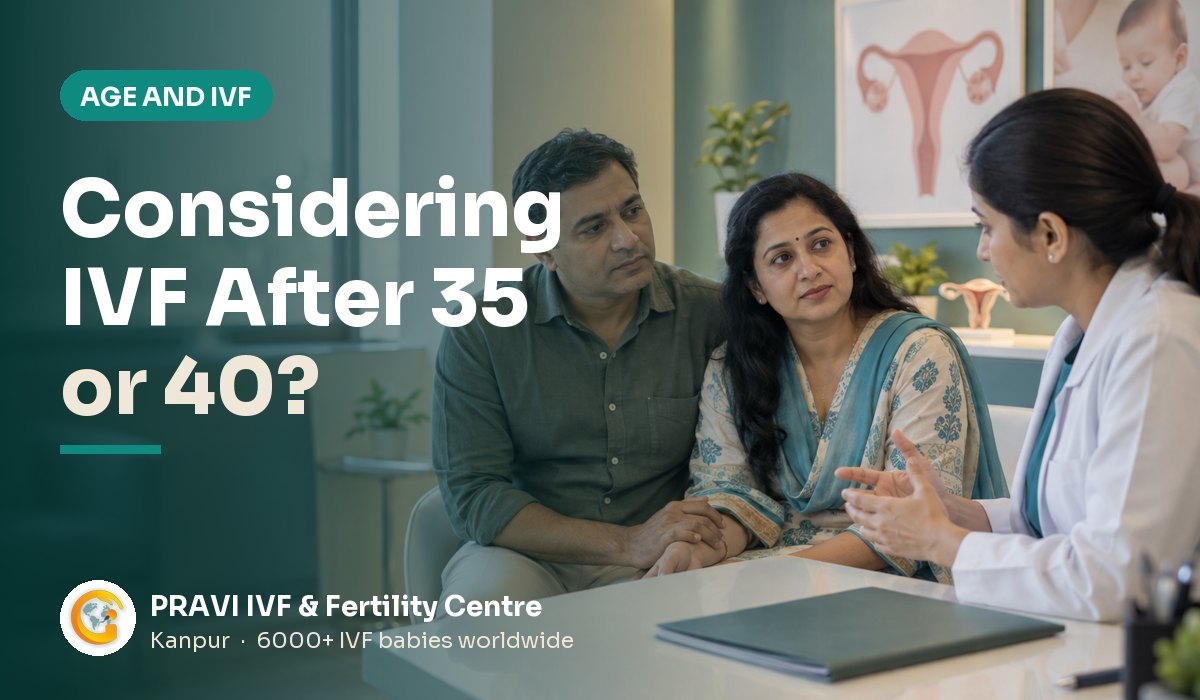
IVF After 35 and 40 in Kanpur
Medically reviewed by Dr. Monica Sachdeva · Updated 12 Oct 2026
Can you have a baby in your late thirties or early forties? Here is a clear, compassionate guide to IVF after 35 and 40 in Kanpur at PRAVI IVF.
When women in their mid-thirties or early forties visit our clinic in Kanpur, they often carry a heavy burden of worry. Relatives and neighbours may have told them that “umar nikal gayi hai” (time has passed) or that pregnancy is no longer possible. Others have tried naturally for several years without results and feel exhausted by well-meaning advice. If you are going through this, take a deep breath. You are not alone, and your dream of holding your baby is still very much alive.
The biological clock is a real medical reality, but modern reproductive science has changed what is possible. Every month at PRAVI IVF & Fertility Centre, we meet couples who started their families later in life due to careers, late marriage, or medical hurdles. With personalized treatment protocols, advanced embryology techniques, and compassionate clinical guidance, having a child in your late thirties or beyond is achievable. Let us walk through what happens to fertility as you age, how IVF in Kanpur works for older couples, and what practical steps you can take today.
Understanding Fertility After 35 and 40
Women are born with all the eggs they will ever have. At birth, a baby girl has around one to two million eggs, but by the time she reaches puberty, that number drops to about 300,000. Through each menstrual cycle, hundreds of eggs are lost as only one matures and releases during ovulation. According to global health data from the World Health Organization, infertility affects millions of reproductive-age individuals worldwide, and age remains one of the strongest physiological factors.
After age 35, two key changes occur. First, the total number of remaining eggs—known as your ovarian reserve—declines at a faster pace. Second, and perhaps more importantly, the cellular quality of those eggs changes. Older eggs are more likely to have minor errors during cell division. This means a higher proportion of embryos may have uneven chromosome numbers (aneuploidy), which can lead to negative pregnancy tests, early miscarriages, or failed implantation.
However, age 35 or 40 is not a sudden cliff; it is a gradual slope. Many women in their late thirties produce healthy, vibrant eggs capable of resulting in a normal pregnancy. The goal of medical evaluation is to assess your individual biological reserve rather than judging your fertility solely by the date on your Aadhaar card.
The Initial Checkup: Testing Your Biological Reserve
Before planning any treatment, our team performs detailed diagnostic tests to understand your unique baseline. We never recommend a standard “one-size-fits-all” cycle because an individual protocol is essential when working with precious eggs. If you live around Swaroop Nagar, Shardha Nagar, or visit our fertility clinic near Pandu Nagar, Kanpur, your assessment begins with clear, simple diagnostics.
We look at several key parameters:
- Anti-Müllerian Hormone (AMH): This simple blood test measures the hormone produced by small follicles in your ovaries. It gives us a strong estimate of your remaining egg count. While an AMH under 1.5 ng/ml indicates a reduced reserve, it does not mean pregnancy is impossible; it simply helps us choose the right medication dose.
- Antral Follicle Count (AFC): Using high-resolution transvaginal ultrasound on Day 2 or 3 of your cycle, our specialists count the visible resting follicles. This scan gives immediate visual confirmation of how responsive your ovaries might be.
- FSH and Estradiol: Measuring these hormones on Day 2 or 3 reveals how hard your brain's pituitary gland is working to stimulate the ovaries.
- Uterine Evaluation (Hysteroscopy or 3D Ultrasound): The uterus ages much more slowly than ovaries. We check for polyps, fibroids, or lining issues that could affect embryo implantation.
- Semen Analysis: Age also impacts sperm motility and DNA fragmentation. A detailed evaluation of the male partner ensures we do not overlook contributing paternal factors.
How IVF Is Customized for Women Over 35 and 40
In standard IVF, young patients are often given moderate doses of gonadotropin injections to produce 10 to 15 eggs. For women in their late thirties and forties, aggressive stimulation can sometimes lower egg quality rather than increase numbers. Under the leadership of Dr. Monica Sachdeva, our Medical Director with over 18 years of experience in reproductive medicine, we tailor every phase to protect egg quality.
Here are the specialized strategies we use for patients over 35 and 40:
1. Mild and Individualized Stimulation Protocols
Instead of overloading the ovaries, we often use antagonist or mild stimulation protocols. Our doctors monitor follicle growth with frequent scans and hormone checks to adjust medications in real time. Dr. Sakshi Tandon and Dr. Ankita (MRCOG, Fellowship in Reproductive Medicine) carefully review cycle progress so that egg retrieval happens at the exact window of peak maturity.
2. ICSI (Intracytoplasmic Sperm Injection)
Because every single egg collected in this age bracket is precious, conventional insemination where sperm swim freely in a dish can risk fertilization failure. With ICSI, our embryologist selects a single, healthy, structurally sound sperm and injects it directly into the mature egg, maximizing fertilization chances.
3. Blastocyst Culture and Advanced Embryology
Growing embryos to Day 5 (the blastocyst stage) lets us observe which embryos demonstrate the vitality to continue dividing. Our laboratory, led by Chief Embryologist Dr. Rit Shukla with a decade of specialized lab experience, maintains rigorous air purity, temperature, and pH control. This protective environment mimics the human fallopian tube and uterus, giving fragile embryos the genuine chance to thrive.
4. Preimplantation Genetic Testing (PGT-A)
As explained by the American Society for Reproductive Medicine, chromosomal abnormalities increase significantly as maternal age advances. PGT-A allows us to safely biopsy a few cells from the outer layer of a Day 5 blastocyst before freezing it. By testing the chromosomes, we can identify which embryos are genetically balanced (euploid). Transferring a tested embryo cuts down the risk of early miscarriage and significantly shortens the time it takes to achieve an ongoing pregnancy.
Comparing Conception Paths After 35 and 40
Couples often ask whether they should keep trying naturally, try basic treatments like IUI, or move straight to IVF. The table below outlines how these paths differ for women over 35:
| Factor | Natural Conception | IUI (Intrauterine Insemination) | Tailored IVF with PGT-A |
|---|---|---|---|
| Time to Result | Uncertain (often 6-12+ months) | Monthly cycle attempts | Structured cycle (4-8 weeks) |
| Egg Number Monitored | Only 1 naturally recruited | 1-2 follicles targeted | Multiple follicles collected & nurtured |
| Embryo Quality Check | None possible | None possible | Day 5 blastocyst grading & chromosomal screening |
| Genuine Suited For | Couples under 35 with open tubes & normal sperm | Mild issues, younger age group, good AMH | Low AMH, tubal blocks, male factor, or age 35+ |
The Vital Role of the Embryology Laboratory
Patients often spend a lot of time researching doctors, but the embryology lab is equally critical, especially when working with delicate eggs. An older egg has a more fragile outer shell (zona pellucida) and fewer cellular energy units (mitochondria). Any small fluctuation in incubator temperature or light can affect its development.
At PRAVI IVF in Swaroop Nagar and Shardha Nagar, our lab uses advanced benchtop incubators, micromanipulators, and laser-assisted hatching. Laser-assisted hatching creates a tiny opening in the embryo's shell before transfer, helping it break through and implant into the uterine lining. You can read more about our personalized clinical methodology through Dr. Monica Sachdeva's approach to IVF in Kanpur.
When Donor Eggs Enter the Conversation
We believe in complete honesty with our patients. While many women between 35 and 42 achieve pregnancy using their own eggs, there are situations where the ovaries no longer produce viable eggs. In such cases, repeated cycles with your own eggs can lead to financial and emotional exhaustion without results.
If tests show an undetectable AMH, high baseline FSH, or repeated failed cycles with severe embryo arrest, our team will gently discuss the option of using donor eggs. Through our ethical and legally compliant donor egg IVF in Kanpur, healthy eggs from young, medically screened Indian donors are fertilized with your husband's sperm. The resulting embryo is carried by you in your womb. For many women over 40, this path offers a very high chance of taking home a healthy baby, allowing them to experience the joy of pregnancy and childbirth.
Understanding the Costs Involved
One of the biggest anxieties couples express is financial uncertainty. When planning IVF after 35 or 40, costs can vary depending on individual medical requirements. A patient with normal ovarian reserve may need standard doses of medication, whereas a patient with diminished reserve may need higher doses of stimulation or an extra round of egg collection to bank embryos.
We do not believe in hidden fees or generic package pricing that surprises families later. During your initial consultation at PRAVI IVF, we evaluate your reports and provide a transparent, written estimate covering your medications, lab procedures, freezing options, and transfer costs. This clarity lets you plan your family journey without unexpected financial stress.
Everyday Steps to Support Your Treatment
Medical treatments do the heavy lifting, but your daily habits can support egg and sperm cellular health during the 90 days leading up to your cycle. You can learn more about general clinical preparation from resources like the Mayo Clinic IVF guide.
Here are sensible, realistic lifestyle habits we recommend to our Kanpur patients:
- Focus on Nutrient-Dense Food: Eat fresh, home-cooked meals with plenty of green vegetables, lentils, seasonal fruits, nuts, and seeds. Avoid refined sugars and trans fats found in packaged snacks.
- Gentle Daily Movement: You do not need punishing gym sessions. A 30-minute brisk walk in Company Bagh, Phool Bagh, or your local park helps blood circulation to the reproductive organs and reduces cortisol levels.
- Supplement Wisely: Under medical supervision, supplements like CoQ10, Vitamin D3, methylfolate, and Melatonin can help combat oxidative stress in ovarian tissue. Do not start random over-the-counter pills without consulting your fertility doctor.
- Protect Your Sleep: Try to get 7 to 8 hours of restful sleep every night. Melatonin produced during deep sleep is a natural antioxidant for maturing follicles.
- Manage Family Pressure: It is completely normal to feel overwhelmed by constant questions from extended family. Protect your peace of mind and share updates only with those who offer steady emotional encouragement.
Your Next Steps Towards Parenthood
Age is a number on your calendar, but your fertility story is written by your unique biology, proper clinical testing, and focused medical care. If you are 35 or older and have been trying to conceive for six months without success, do not wait. Early evaluation gives you more options and protects your time.
Dr. Monica Sachdeva and the entire specialist team at PRAVI IVF & Fertility Centre are here to guide you with warmth, clear answers, and scientific excellence. Whether you wish to visit our centre in Swaroop Nagar or Shardha Nagar in Kanpur, or our polyclinic in Lajpat Nagar, Delhi, we are ready to listen to your story. Book an appointment with our fertility specialists today or reach out through our contact page to take your first confident step toward holding your baby.
Frequently asked questions
What is the cut-off age for IVF treatment in India?
Under the Assisted Reproductive Technology (ART) Act of India, the upper legal age limit for a woman to undergo ART treatments like IVF is 50 years, and for a man, it is 55 years. However, medical suitability depends on your overall health, cardiac fitness, and uterine condition, which our specialists assess carefully.
Can I get pregnant with my own eggs after 40 in Kanpur?
Yes, many women aged 40 and above conceive using their own eggs if they still have an adequate ovarian reserve. Success depends on individual AMH levels, antral follicle count, and embryo quality. Our team often recommends PGT-A screening to ensure only chromosomally normal embryos are transferred.
Why is AMH testing so important for women over 35?
AMH indicates the remaining pool of growing follicles in your ovaries. After age 35, AMH levels naturally decline. Knowing your AMH helps Dr. Monica Sachdeva choose the most effective medication dose and sets realistic expectations regarding how many eggs we can expect to retrieve in a single cycle.
How does PGT-A help older couples undergoing IVF?
PGT-A tests the chromosomal health of Day 5 blastocysts before transfer. Since older eggs carry a higher chance of chromosomal imbalances, selecting and transferring a verified euploid embryo significantly lowers miscarriage rates and improves implantation success.
What if my ovarian reserve is too low for regular IVF?
If your ovarian reserve is severely diminished, we have several medical options. These include mild stimulation, pooling embryos across multiple cycles, or utilizing donor eggs from young, healthy donors through our ethically compliant donor programme.
Does male age matter when conceiving after 35?
Yes, male age also influences fertility outcomes. While men produce sperm throughout life, sperm motility, morphology, and DNA integrity tend to decline after age 40 to 45. We conduct comprehensive semen evaluations and use advanced ICSI to select the healthiest sperm for fertilization.
How long should I try naturally before seeing a fertility doctor if I am over 35?
If you are 35 or older, clinical guidelines recommend consulting a fertility doctor after six months of regular, unprotected intercourse without pregnancy. If you are 40 or older, it is wise to seek a fertility evaluation right away without waiting.
How much does IVF after 35 or 40 cost at PRAVI IVF in Kanpur?
The overall cost depends on individual medical factors such as the dosage of hormonal injections required, whether ICSI or PGT-A testing is needed, and whether embryo freezing is planned. At PRAVI IVF, we conduct a thorough assessment first and provide a transparent, itemized written estimate so you can plan clearly without hidden surprises.