
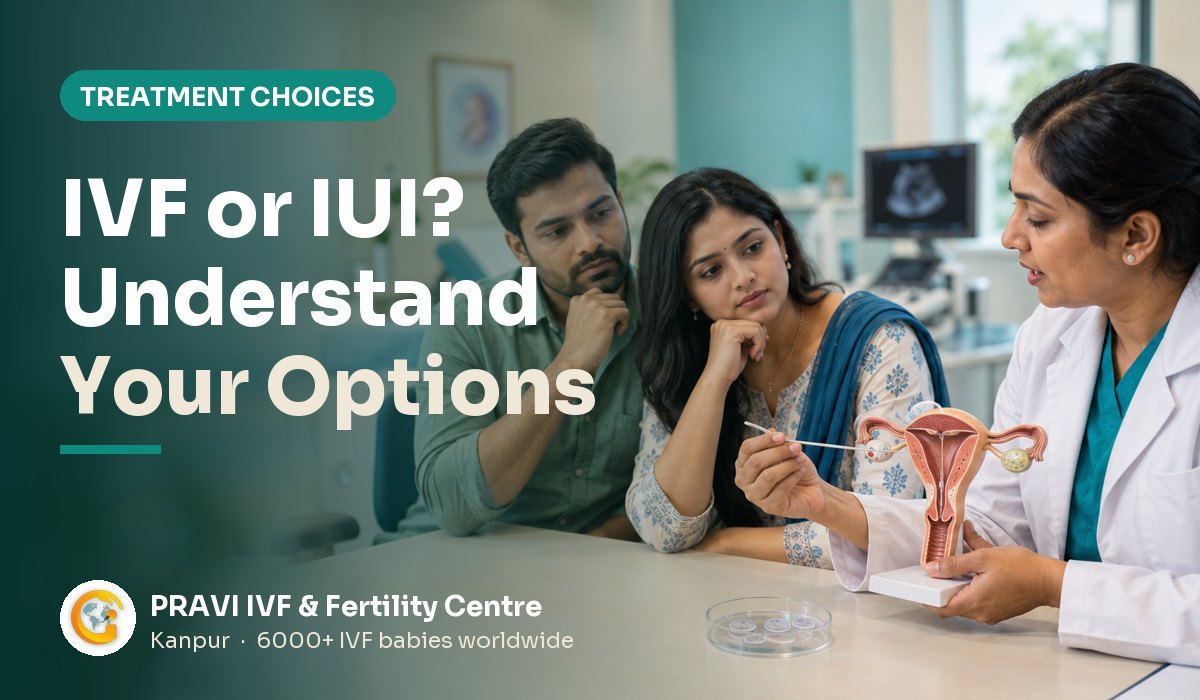
IVF vs IUI: Which Is Right for You in Kanpur
Medically reviewed by Dr. Monica Sachdeva · Updated 12 Oct 2026
Choosing between IUI and IVF can feel overwhelming when planning your fertility journey. This guide explains how both treatments work, who they help most, and how our team in Kanpur helps you choose the right path.
When you and your partner decide it is time to seek medical support to grow your family, the medical terms can feel confusing. Many couples visiting our clinics in Swaroop Nagar and Shardha Nagar tell us that the hardest part is simply knowing where to begin. You might hear family members or friends recommend a test tube baby procedure, while others suggest starting with simpler medical steps. It is natural to feel caught in a quiet dvidha (dilemma) about what step makes medical and financial sense.
Two of the most common assisted reproductive treatments are Intrauterine Insemination (IUI) and In Vitro Fertilization (IVF). While both treatments help couples overcome fertility challenges, they work quite differently. According to the World Health Organization, infertility affects millions of people globally, yet the right treatment depends entirely on your specific biological needs.
Under the guidance of Dr. Monica Sachdeva, Medical Director at PRAVI IVF & Fertility Centre, our philosophy is to recommend the simplest, least invasive treatment that gives you a safe and realistic chance of bringing home a healthy baby. Here is a clear, step-by-step breakdown of IVF vs IUI to help you understand your choices.
Understanding IUI (Intrauterine Insemination)
Intrauterine Insemination, or IUI, is often considered a first-line medical treatment because it works closely with your body's natural cycle. In simple words, IUI gives healthy sperm a head start by placing them directly inside the woman's uterus around the time an egg is released.
During a natural cycle, millions of sperm must travel through the cervix and swim into the fallopian tube, where fertilization occurs. With IUI, this journey is made much shorter. The partner's or donor's semen sample is prepared in our specialized laboratory to separate the fastest, healthiest sperm from the seminal fluid.
The selected sperm are then transferred gently into the uterine cavity using a soft, thin catheter. The procedure is quick, takes only a few minutes, and feels very similar to a routine pelvic exam. No anesthesia or hospital stay is required. If you want to understand the complete cycle breakdown, you can read more about our dedicated IUI treatment in Kanpur.
When is IUI Usually Recommended?
IUI works genuine when the underlying fertility barriers are mild. It is an effective option for couples who have been trying for a shorter duration or where specific reproductive conditions are met:
- Open Fallopian Tubes: The woman must have at least one completely healthy, unblocked fallopian tube, as fertilization still takes place inside the body.
- Mild Male Factor Infertility: If sperm count or motility is slightly below normal ranges, laboratory washing helps concentrate the genuine-moving sperm. A baseline semen analysis test in Kanpur is the first step to checking this parameter.
- Ovulation Irregularities: Women with conditions like mild Polycystic Ovary Syndrome (PCOS) who do not release eggs regularly can benefit from light oral medication combined with IUI.
- Cervical Factor Issues: If cervical mucus is hostile to sperm or if there is scar tissue on the cervix, IUI bypasses that barrier entirely.
- Unexplained Infertility: Couples with normal test results who have struggled to conceive naturally often begin with 2 to 3 IUI cycles.
Understanding IVF (In Vitro Fertilization)
In Vitro Fertilization, commonly known as IVF, is a more advanced medical procedure. In IVF, the process of fertilization takes place outside the human body in a controlled laboratory environment. The term "in vitro" literally translates to "in glass," referring to laboratory culture dishes.
Unlike IUI, where medications encourage only one or two eggs to mature, IVF uses gentle hormone injections over 8 to 12 days to stimulate the ovaries to mature multiple eggs. During this period, our specialists perform routine ultrasound scans and blood hormone tests to track egg growth safely.
When the eggs are mature, an egg retrieval procedure is performed under short, light sedation so you feel no discomfort. Dr. Rit Shukla, our Chief Embryologist with a decade of laboratory expertise, and our clinical team then combine these eggs with the prepared sperm in our state-of-the-art embryology cleanroom. In cases where sperm cannot penetrate the egg on its own, an advanced technique called ICSI (Intracytoplasmic Sperm Injection) is used, where a single healthy sperm is injected directly into each egg.
The fertilized eggs grow into embryos over 3 to 5 days. Finally, one or two healthy embryos are transferred back into the mother's uterus. For couples who need advanced care or have traveled from nearby areas, visiting an established test tube baby centre near Barra, Kanpur ensures access to modern lab incubation systems.
When is IVF the Clearer and Better Choice?
While IVF involves more steps than IUI, it offers solutions for reproductive barriers that simpler treatments cannot solve. As detailed by the Mayo Clinic, IVF is the gold standard when natural fertilization inside the fallopian tube is unlikely or impossible:
- Blocked or Damaged Fallopian Tubes: If both tubes are blocked, damaged, or previously removed, sperm and egg cannot meet naturally. IVF completely bypasses the fallopian tubes.
- Severe Male Infertility: When sperm count is very low, motility is sluggish, or sperm shape is abnormal, standard IUI will not work. Techniques like ICSI alongside IVF overcome these hurdles.
- Moderate to Severe Endometriosis: Severe endometriosis can distort pelvic anatomy and affect egg quality, making IVF a more direct and successful option.
- Advanced Maternal Age or Diminished Ovarian Reserve: When time is an important factor and egg numbers are declining, IVF provides higher cumulative chances per month of treatment.
- Repeated Failed IUI Cycles: If three well-monitored IUI attempts do not result in a pregnancy, continuing with IUI rarely improves outcomes. Moving to IVF is the recommended clinical next step.
- Need for Genetic Screening: Couples with recurring miscarriages or known hereditary risks can utilize PGT-A genetic testing in Kanpur to check embryos for chromosomal balance before transfer.
Comparing IVF vs IUI: Key Differences
To help you see the practical differences clearly, here is a straightforward comparison of how both procedures work side by side:
| Feature | IUI (Intrauterine Insemination) | IVF (In Vitro Fertilization) |
|---|---|---|
| Where Fertilization Occurs | Inside the woman's fallopian tube (natural fertilization). | Inside the advanced embryology lab dish. |
| Fallopian Tubes Needed? | Yes, at least one healthy and open tube is mandatory. | No, fallopian tubes are completely bypassed. |
| Treatment Duration | Roughly 2 weeks from the start of your cycle to the insemination. | Around 4 to 6 weeks for stimulation, retrieval, and transfer. |
| Anesthesia Needed? | No, completely awake and painless like a routine smear. | Mild, short anesthesia only during egg collection. |
| Sperm Quality Requirements | Requires moderate to normal moving sperm counts. | Can work even with very low counts using ICSI or TESA. |
| Embryo Evaluation | Not possible, as embryo develops inside the body. | Embryos are monitored daily and graded by embryologists. |
Understanding Success: What Influences the Outcome?
Couples often ask us for an exact percentage guarantee. In ethical medicine, no clinic can promise a 100% result. However, reputable clinics maintain a high success rate by tailoring protocols to each patient rather than applying a standard formula. According to patient education resources from the American Society for Reproductive Medicine, outcomes in assisted reproduction depend on several individual health factors.
Here are the primary factors that influence both IUI and IVF outcomes:
- Female Age: Age influences egg quantity and chromosomal health. Younger women generally have healthier eggs, but personalized medication protocols help women in their mid-to-late thirties achieve safe pregnancies as well.
- Quality of the Uterine Lining: The endometrium must be receptive, thick, and healthy for an embryo to attach. Diagnostic hysteroscopy can identify and treat polyps or adhesions prior to any transfer.
- Sperm DNA Quality: Beyond basic sperm count, sperm DNA fragmentation impacts both fertilization and early embryo development.
- Laboratory Environment: For IVF, the cleanroom standards, air filtration, and skill of the embryology team play a decisive role in helping embryos reach the blastocyst stage.
Generally speaking, IVF delivers a higher success rate per single cycle than IUI because it removes the uncertainty of whether fertilization actually occurred. However, for a young couple with open tubes and mild issues, starting with IUI is a medically sensible, cost-effective first step.
Cost Factors: Making a Practical Financial Decision
Cost is a real consideration for every family in Uttar Pradesh. When comparing the investment for IVF vs IUI, it is helpful to look at the overall picture rather than just the initial price tag.
IUI is considerably less expensive per cycle than IVF. It involves minimal medication, simple ultrasound monitoring, and a quick outpatient procedure. For this reason, many couples choose to attempt up to three cycles of IUI. However, if multiple IUI attempts fail, the cumulative cost and emotional fatigue can add up without bringing answers.
IVF requires a larger investment because of daily hormone injections, specialized egg collection equipment, anesthesia, and high-grade embryology lab culture systems. At PRAVI IVF, we do not believe in hidden fees or unexpected bills midway through your treatment. Following your preliminary evaluation, our team provides a transparent written estimate outlining medication, laboratory, and procedure charges so you can plan with total clarity.
How Our Doctors Help You Decide in Kanpur
At our Swaroop Nagar and Shardha Nagar centres, we follow a simple rule: we listen first. Infertility is not just a medical diagnosis; it carries personal stress, family expectations, and emotional strain. Our fertility specialists, including Dr. Sakshi Tandon and Dr. Ankita (MRCOG, Fellowship in Reproductive Medicine), perform thorough, evidence-based assessments before recommending any intervention.
Your diagnostic evaluation will typically include:
- A detailed medical and reproductive history review.
- High-resolution transvaginal ultrasound to assess your antral follicle count and uterine structure.
- Hormonal tests, including Anti-Müllerian Hormone (AMH), thyroid, and prolactin levels.
- A tubal patency evaluation, such as an HSG (Hysterosalpingography) or diagnostic laparoscopy, if IUI is being considered.
- A comprehensive semen analysis to evaluate count, motility, and morphology.
If your test results reveal clear fallopian tubes and adequate sperm parameters, Dr. Monica Sachdeva may suggest starting with monitored IUI cycles. If severe male factor issues, blocked tubes, or diminished ovarian reserve are detected, our team will explain clearly why moving directly to IVF offers you the safest and fastest route to parenthood, sparing you unnecessary months of disappointment.
Take the First Confident Step Today
Whether your fertility path leads to a simple IUI or an advanced IVF cycle, the most important step is getting an accurate medical evaluation. You do not have to navigate this uncertainty alone or rely on guesswork. Reach out to our compassionate team, visit us at our Kanpur centres, or explore our services in Delhi to find answers tailored specifically to your body. We are here to support you at every milestone of your parenthood journey. Please contact our clinic team today or book your private fertility appointment to take your next step forward with confidence.
Frequently asked questions
Is IUI painful for the female partner?
No, IUI is generally not painful. It is an outpatient procedure performed without anesthesia that feels very similar to a routine pap smear or pelvic examination, with only mild cramping reported by some women.
How many cycles of IUI should we try before considering IVF?
Most reproductive specialists recommend trying between 2 to 3 well-monitored IUI cycles. If pregnancy does not occur after 3 attempts, continuing with IUI rarely improves cumulative success, making IVF the recommended next step.
Can IUI work if my fallopian tubes are blocked?
No, IUI cannot work if both fallopian tubes are blocked because the sperm and egg must meet inside the tube for natural fertilization. If both tubes are obstructed, IVF is the medically indicated treatment because it bypasses the tubes entirely.
Does IVF require complete bed rest after embryo transfer?
No, complete bed rest is not required or medically recommended after an embryo transfer. Patients can resume their normal, light daily routines the very next day while avoiding heavy lifting, strenuous workouts, and excessive physical stress.
What is the difference between IVF and ICSI?
In traditional IVF, thousands of sperm are placed around an egg in a dish, allowing one sperm to fertilize it naturally. In ICSI, a single healthy sperm is selected by our embryologist and injected directly into the egg, which is ideal for severe male factor infertility.
Can we switch from IUI to IVF immediately if a cycle fails?
Yes, you can transition from an unsuccessful IUI cycle to an IVF cycle fairly quickly. Your fertility doctor will evaluate your ovaries via ultrasound, adjust your treatment protocol, and typically begin your IVF cycle with your next menstrual period.
What diagnostic tests are needed before deciding between IVF and IUI in Kanpur?
Before choosing a path, couples undergo baseline hormone testing (such as AMH and thyroid levels), a comprehensive semen analysis for the male partner, a pelvic ultrasound, and a tubal patency test like an HSG to verify whether the fallopian tubes are open.
Why does PRAVI IVF provide a written cost estimate after the first consultation?
Every patient's reproductive health is unique, requiring different medication dosages, monitoring schedules, or advanced laboratory techniques. Providing a detailed written estimate after consultation ensures complete financial transparency without unexpected hidden charges during your treatment.