
PGT-A Genetic Testing in Kanpur
Medically reviewed by Dr. Rit Shukla · Updated 12 Oct 2026
Discover how PGT-A genetic testing in Kanpur helps couples screen embryos for chromosomal balance, reduce miscarriage risks, and improve IVF success.
When you start an IVF journey, your only dream is to hear the sweet sound of a heartbeat and bring a healthy baby home. Yet, for many couples, the road brings unexpected heartbreak. A negative pregnancy test or an early miscarriage can break your spirit. You often ask yourself, "Sab kuch theek tha, fir kya kami reh gayi?"
In many cases, the hidden reason behind an IVF failure is not your uterus or your daily routine. It is a microscopic chromosomal problem inside the embryo itself. This is where PGT-A Genetic Testing in Kanpur offers new clarity and hope. By checking embryos before they are transferred to the womb, this advanced reproductive test helps our team select embryos with the genuine chance of leading to a full-term pregnancy.
At PRAVI IVF & Fertility Centre, our Kanpur clinics in Swaroop Nagar and Shardha Nagar bring world-class embryology to your doorstep. Guided by Medical Director Dr. Monica Sachdeva, Chief Embryologist Dr. Rit Shukla, Dr. Sakshi Tandon, and Dr. Ankita, we walk alongside you with clinical skill and genuine warmth.
What Is PGT-A Genetic Testing?
PGT-A stands for Preimplantation Genetic Testing for Aneuploidies. In simpler words, it is a laboratory test that checks whether an embryo has the right number of chromosomes. A healthy human cell carries 46 chromosomes, arranged in 23 pairs. One set comes from the egg, and the other comes from the sperm.
Sometimes, an embryo ends up with too few or too many chromosomes. This condition is called aneuploidy. An embryo with 45 or 47 chromosomes might look completely perfect under a standard laboratory microscope. However, if transferred, it often fails to implant or leads to an early pregnancy loss. You can learn more about general embryo health from trusted international resources like ReproductiveFacts.org.
PGT-A does not alter or modify your embryo's genetics. Instead, it acts like an advanced screening tool. It identifies which embryos are chromosomally balanced (euploid) before transfer takes place. At PRAVI IVF, our dedicated PGT services in Kanpur give hopeful parents scientific reassurance before taking the next step.
Why Normal Looking Embryos Still Fail
For decades, embryologists had to choose embryos based only on their physical appearance under a microscope. An embryo was given a grade, such as 4AA or 3BB, based on its shape, cell symmetry, and expansion speed. While visual grading is still very useful, it has clear limits.
Research shows that even genuine-grade, beautiful blastocysts can carry major chromosomal errors. When such an embryo is placed inside the womb, nature usually stops its growth. This results in either a failed implantation or an early miscarriage. For a woman, going through repeated transfers without knowing the reason creates deep emotional fatigue.
PGT-A looks deeper than surface appearance. It gives our clinical team genetic data so we only transfer embryos that have the biological tools needed to grow into a healthy baby. This focused strategy saves you precious time, shields your physical health, and protects your peace of mind.
Who Should Consider PGT-A Genetic Testing in Kanpur?
PGT-A is not mandatory for every couple who walks through our doors. However, specific medical situations make it a valuable clinical tool. We often recommend discussing PGT-A during your consultation if you fit into one of the following groups:
- Women Aged 35 and Above: As women age, the natural quality of their eggs declines. By age 37 or 40, more than half of the embryos produced may be chromosomally abnormal. PGT-A filters out these abnormal embryos, giving older women a high success rate per transfer.
- Couples with Recurrent Miscarriages: Losing two or more pregnancies in a row is heartbreaking. In over 60 percent of early pregnancy losses, chromosomal abnormalities are the direct cause. PGT-A helps break this painful cycle.
- Repeated IVF Failures: If you have already undergone two or more IVF cycles with good quality embryos that failed to attach, the problem may lie in unspotted genetic errors.
- Severe Male Factor Infertility: When sperm count, motility, or morphology is severely affected, or when sperm DNA fragmentation is high, the risk of chromosomal imbalances in embryos rises.
- Desire for a Confident Single Embryo Transfer: Many couples want to avoid twin or triplet pregnancies due to medical risks. Transferring one genetically tested euploid embryo gives you the safety of a singleton pregnancy along with maximum implantation potential.
Undergoing repeated fertility treatments takes a heavy psychological toll on both partners. We always emphasize that seeking emotional support during IVF in Kanpur is just as important as medical testing during your fertility path.
Step-by-Step: How PGT-A Works at PRAVI IVF
Patients often wonder how an embryo can be tested without harming it. The procedure is delicate, highly controlled, and carried out inside our cleanroom embryology laboratory. Here is the typical step-by-step path at our Kanpur clinics:
1. Ovarian Stimulation and Egg Retrieval
Your cycle begins with tailored hormonal medications to encourage your ovaries to mature several eggs. Dr. Monica Sachdeva and Dr. Ankita monitor your follicular growth closely using ultrasound scans and blood hormone levels. When the follicles are ready, a trigger shot is given, followed by a gentle egg retrieval under short sedation.
2. ICSI Fertilization and Blastocyst Culture
To ensure clear genetic results, the eggs are fertilized using Intracytoplasmic Sperm Injection (ICSI). This prevents extra sperm cells from sticking to the outside of the egg, which could interfere with the genetic test. The fertilized eggs are grown in advanced incubators until Day 5 or Day 6, reaching the blastocyst stage where they contain over one hundred cells.
3. The Precision Embryo Biopsy
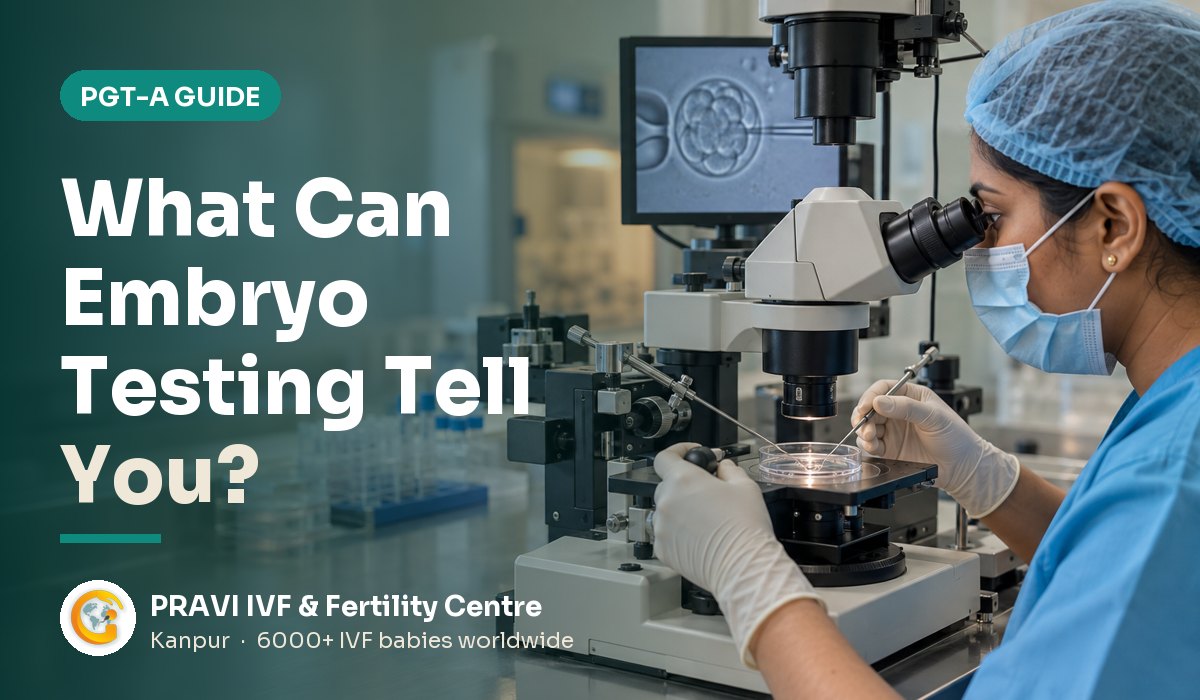
Once the embryo reaches the blastocyst stage, it divides into two parts: an inner cell mass (which becomes the baby) and the trophectoderm (which forms the placenta). Under the direction of Chief Embryologist Dr. Rit Shukla, our lab team uses a gentle laser to make a tiny opening in the outer shell. A specialized micro-pipette carefully removes 4 to 6 cells from the trophectoderm layer only. The inner cell mass is left completely untouched.
4. Vitrification (Safe Freezing)
Immediately after the biopsy, each embryo is frozen individually using rapid vitrification. They stay preserved safely in liquid nitrogen tanks while the removed cell samples are sent for Next-Generation Sequencing (NGS) analysis. Studies documented by clinical organizations like the Mayo Clinic show that properly vitrified blastocysts maintain high survival rates upon thawing.
5. Genetic Analysis and Reporting
The genetic laboratory analyzes the DNA of the biopsied cells using modern Next-Generation Sequencing. The final report categorizes each embryo as euploid (normal), aneuploid (abnormal), or occasionally mosaic (a mix of normal and abnormal cells). Our clinical specialists sit down with you to review the results in simple, understandable words.
6. Frozen Embryo Transfer (FET)
Once we identify your healthy euploid embryo, we prepare your uterine lining. Transferring a tested embryo into an optimally prepared uterus creates the genuine conditions for implantation and a healthy pregnancy.
Understanding the Differences: Standard IVF vs IVF with PGT-A
Choosing whether to add genetic testing to your IVF cycle is a personal and medical decision. Here is a quick comparison of what the two pathways look like:
| Feature | Standard IVF / ICSI | IVF with PGT-A |
|---|---|---|
| Embryo Selection | Based on visual appearance and cell grading only | Based on both visual appearance and chromosomal health |
| Miscarriage Risk | Higher, especially in women over 35 years | Significantly reduced due to screening out aneuploid embryos |
| Time to Pregnancy | May require multiple transfers to find a healthy embryo | Often shorter because abnormal embryos are not transferred |
| Cycle Timeline | Fresh or frozen embryo transfer in Day 3 to Day 5 | Requires embryo freezing while waiting for genetic results |
| Embryo Biopsy | Not performed | Requires blastocyst biopsy by an experienced embryologist |
Addressing Common Myths and Patient Worries
It is natural to have questions when you hear about genetic testing on your future baby. Let us clear up some of the most frequent concerns couples share with us at our Swaroop Nagar and Shardha Nagar clinics:
Does the biopsy hurt the embryo or cause birth defects?
When performed by an expert embryologist, the risk of damaging an embryo during a blastocyst biopsy is very low (less than 1 percent). Because cells are removed only from the outer layer that forms the placenta, the baby's core development is not affected. Millions of healthy children have been born worldwide following PGT-A testing.
Can PGT-A fix an abnormal embryo?
No, PGT-A cannot fix or cure an abnormal embryo. It only acts as an informational test. It tells us which embryos have the right chromosomes and which do not. This protects you from transferring embryos that have no chance of survival.
Can we choose our baby's gender through PGT-A?
No. Sex selection is strictly illegal in India under the Pre-Conception and Pre-Natal Diagnostic Techniques (PC-PNDT) Act and the Assisted Reproductive Technology (Regulation) Act, 2021. You can review the Indian legal framework on the India Code ART Act Portal. At PRAVI IVF, we strictly follow all Indian laws. PGT-A is used purely for medical screening of chromosomal disorders, and gender information is never tested, documented, or shared.
Preparing Your Uterus for a Tested Embryo
Having a genetically normal embryo is a huge milestone, but the embryo also needs a receptive, healthy home. An embryo cannot implant well if the endometrium (the inner lining of the uterus) is unhealthy or too thin. That is why our specialists pay close attention to your uterine health before any transfer.
If our scans show lining issues, we offer specialized protocols such as thin endometrium treatment in Kanpur to build thickness and blood flow. Combining a confirmed euploid embryo with a receptive endometrial environment provides the highest chance of holding your baby in your arms.
The Cost of PGT-A Genetic Testing in Kanpur
Patients frequently ask us about the exact cost of PGT-A testing. Because every couple's fertility plan is unique, the total cost depends on several individual factors:
- The Number of Embryos Biopsied: Genetic laboratories generally charge per embryo tested or in tiered batches (for example, testing up to 4 or 8 embryos).
- Laboratory Testing Platform: Advanced Next-Generation Sequencing (NGS) provides high-resolution data, and equipment maintenance requires strict quality standards.
- Embryo Freezing and Storage: Vitrification and ongoing cryopreservation fees cover the safe storage of your embryos while waiting for reports.
- Medication and Preparation: Hormonal protocols used to prepare the uterus for a frozen transfer vary depending on your body's response.
At PRAVI IVF, we believe that medical costs should never come as a surprise. We do not provide random estimates over the phone. Instead, after evaluating your egg count, sperm health, and expected embryo numbers, our counselors provide a complete, itemized written estimate so you can plan with confidence.
Serving Kanpur and Surrounding Districts
Advanced reproductive genetics should not require constant, tiring travel to distant metro cities. Our full-service facilities in Swaroop Nagar and Shardha Nagar make world-class care accessible right here in Kanpur. We also regularly welcome families from nearby areas, serving as a trusted IVF centre for Unnao patients, as well as couples visiting us from Orai, Jalaun, Fatehpur, and Farrukhabad.
Our clean embryology labs, ethical medical guidance, and compassionate staff ensure you receive the same clinical care available in genuine global fertility clinics, close to home.
Why Families Trust PRAVI IVF & Fertility Centre
Undergoing IVF with PGT-A requires teamwork between skilled doctors and an advanced laboratory. Here is what sets the PRAVI IVF team apart:
- Experienced Leadership: Medical Director Dr. Monica Sachdeva brings over 18 years of specialized experience in reproductive medicine, managing both routine and complex fertility challenges.
- High-End Embryology: Chief Embryologist Dr. Rit Shukla has a decade of hands-on laboratory experience in micromanipulation, laser biopsy, and embryo vitrification.
- Complete Gynaecological Care: Dr. Sakshi Tandon and Dr. Ankita (MRCOG, Fellowship in Reproductive Medicine, Diploma in Minimal Access Surgery) provide comprehensive medical and surgical care.
- Transparent Ethics: We keep you fully informed at every stage of embryo development. You receive clear reports and honest guidance without false promises.
- A Caring Environment: We know the pain infertility can bring. Our nurses, embryologists, and doctors treat your hopes and your embryos with the utmost gentleness and respect.
If you have suffered through unexplained IVF failures or miscarriages, do not lose your himmat. Modern science offers reliable answers, and you do not have to walk this road by yourself. To understand whether PGT-A genetic testing is the right choice for your family, please visit us at PRAVI IVF in Kanpur. You can easily schedule an initial discussion through our appointment booking page or reach out to our caring team directly via our contact page today.
Frequently asked questions
What is the difference between PGT-A, PGT-M, and PGT-SR?
PGT-A checks for random numerical chromosomal abnormalities like an extra or missing chromosome. PGT-M tests for specific single-gene inherited disorders like thalassemia when parents are known carriers. PGT-SR screens for structural chromosomal rearrangements such as balanced translocations.
Does PGT-A genetic testing guarantee a 100% successful pregnancy?
While PGT-A significantly improves implantation rates and reduces miscarriage risks by identifying balanced embryos, no medical test can guarantee 100 percent success. Implantation also depends on uterine receptivity, blood flow, hormonal balance, and maternal health.
Is the embryo biopsy procedure safe for my embryos?
Yes, when performed by a skilled embryologist, the biopsy is very safe with less than a 1 percent risk of damage. Cells are taken exclusively from the trophectoderm layer, which forms the placenta, leaving the inner cells that become the baby completely untouched.
How long does it take to get the PGT-A results in Kanpur?
The genetic testing process usually takes around 2 to 3 weeks after the biopsy. During this period, your embryos remain safely frozen in liquid nitrogen at our Kanpur laboratory until your personalized transfer cycle is scheduled.
Can PGT-A detect all birth defects and health issues?
PGT-A only screens for numerical chromosomal imbalances such as Down syndrome or Turner syndrome. It does not screen for non-chromosomal birth defects, autism, developmental delays, or minor anatomical problems.
Is sex selection permitted during PGT-A testing in India?
No, sex selection is completely illegal in India under the PC-PNDT Act and ART Act. At PRAVI IVF, we strictly comply with Indian law; gender is neither identified nor disclosed, and testing is performed solely for medical and genetic viability.
What happens if all of my embryos turn out to be abnormal?
While this is emotionally difficult, it provides valuable clinical information about why earlier cycles may have failed. Our doctors will discuss your cycle thoroughly, review stimulation protocols, and explore options like fresh cycles with modified protocols or donor options.
Can I do a fresh embryo transfer if I choose PGT-A?
No, because the genetic analysis takes 2 to 3 weeks, embryos must be vitrified (frozen) after the biopsy. A frozen embryo transfer is then scheduled once results are confirmed and your uterine lining is hormonally prepared.