
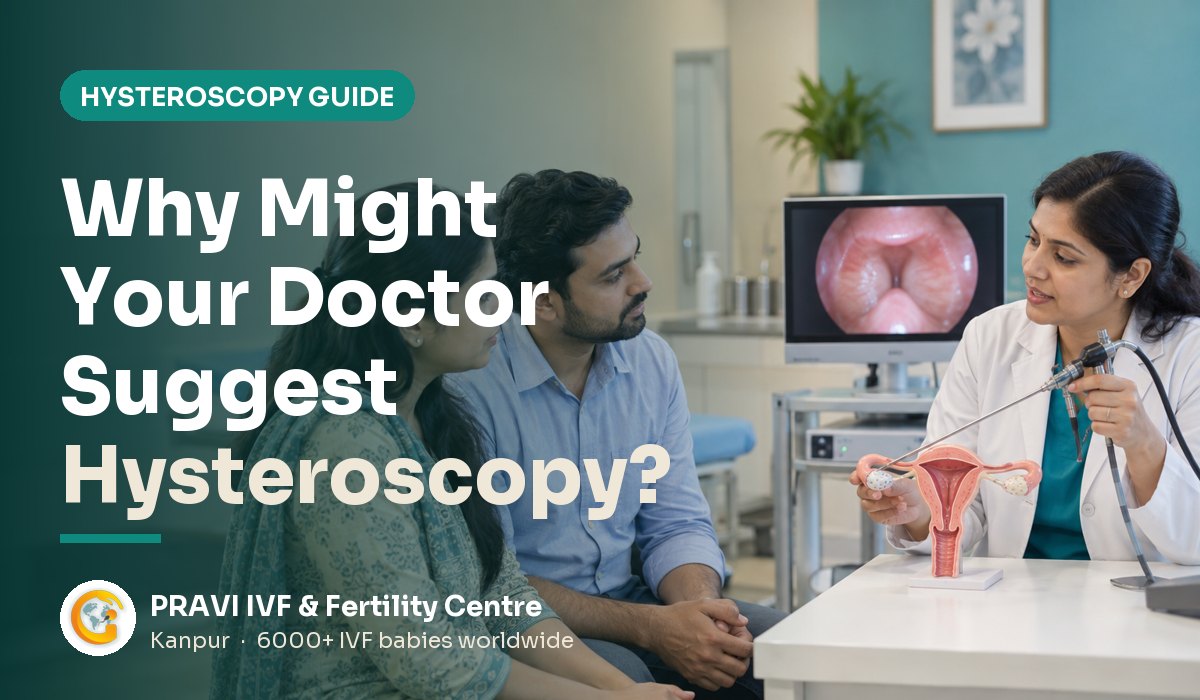
Hysteroscopy for Infertility in Kanpur
Medically reviewed by Dr. Ankita · Updated 12 Oct 2026
Learn how hysteroscopy for infertility in Kanpur diagnoses and treats uterine conditions, helping couples improve their chances of conceiving naturally or through IVF.
When you have been trying to have a baby for months or years, every negative test brings a quiet heartbreak. Many couples in Uttar Pradesh visit clinic after clinic, completing blood tests and semen analyses without finding a clear answer. If your tests look normal, but pregnancy still does not happen, the answer might be resting quietly inside the uterus.
At PRAVI IVF & Fertility Centre in Kanpur, we often meet couples who feel completely exhausted by this waiting. To build a healthy pregnancy, you need both a healthy embryo and a welcoming womb. When the inner lining of the womb has small obstacles, an embryo cannot stick. This is where Hysteroscopy for Infertility in Kanpur plays a life-changing role.
Under the clinical guidance of our fertility specialist and laparoscopic surgeon, Dr. Ankita, we use modern, gentle hysteroscopy techniques to view the uterine cavity directly. This helps us find and fix hidden issues without painful cuts or long hospital stays.
What Is Hysteroscopy and Why Is It Performed?
A hysteroscopy is a simple, precise procedure that allows a fertility doctor to look directly inside your womb (uterus). The doctor passes a very thin, lighted telescope called a hysteroscope through the natural opening of your vagina and cervix. There are no cuts or stitches on your abdomen.
According to clinical data from the World Health Organization (WHO), millions of couples face reproductive challenges, and structural uterine factors cause a notable portion of these delays. An ultrasound or an X-ray (HSG) can show shadows, but only a hysteroscope gives a clear, real-time video view of the uterine walls and the lining where your baby must grow.
At our fertility clinic in Shardha Nagar, Kanpur, as well as our Swaroop Nagar centre, we perform hysteroscopy to answer one primary question: Is the womb ready and safe to hold a pregnancy?
The Seed and the Soil: Why the Uterine Lining Matters
Think of conception like planting a delicate plant. The sperm and egg create a healthy embryo, which is the seed. However, even the healthiest seed cannot grow if the soil is rocky, infected, or scarred. The uterus is that soil.
If the uterine cavity has tiny growths or an abnormal shape, the embryo may fail to attach. Even if it attaches, it might not receive enough blood flow, leading to an early miscarriage. For families eagerly waiting for good news—what we warmly call khushkhabri—discovering and clearing these uterine problems turns years of frustration into renewed hope.
When you choose advanced hysteroscopy in Kanpur at PRAVI IVF, our goal is to restore the natural health of this lining so implantation can happen smoothly.
Two Types of Hysteroscopy: Diagnostic and Operative
Hysteroscopy is divided into two clear steps depending on what your doctor needs to accomplish during your visit:
- Diagnostic Hysteroscopy: This is a quick check to inspect the inside of the womb. The doctor looks at the shape of the cavity, the color and texture of the endometrium, and the openings of the fallopian tubes. It usually takes only 10 to 15 minutes.
- Operative Hysteroscopy: If the doctor finds an issue during the exam, small surgical instruments can be passed through the hysteroscope to treat the problem right away. This approach is often called “see-and-treat.” It saves you from having multiple procedures.
| Feature | Diagnostic Hysteroscopy | Operative Hysteroscopy |
|---|---|---|
| Primary Purpose | To look, evaluate, and confirm uterine health | To treat, remove, or repair uterine issues |
| Average Duration | 10 to 15 minutes | 20 to 45 minutes |
| Anesthesia Used | Local anesthesia or mild sedation | Short general or regional anesthesia |
| Recovery Time | Go home within 1 to 2 hours | Go home the same day; rest for 24 hours |
What Uterine Conditions Can Hysteroscopy Detect and Treat?
Many uterine conditions do not cause any daily pain or heavy bleeding. Women often have no idea anything is wrong until they struggle to get pregnant. Research summarized by American Society for Reproductive Medicine (ReproductiveFacts.org) shows that treating these cavity issues greatly improves clinical pregnancy rates.
1. Endometrial Polyps
Polyps are soft, finger-like fleshy growths on the inner wall of the womb. Even tiny polyps measuring a few millimeters can act like a natural contraceptive device. They trigger mild inflammation that prevents the embryo from implanting. During hysteroscopy, we remove them smoothly without harming the surrounding lining.
2. Submucosal Fibroids
Fibroids are benign muscle knots in the uterus. While fibroids on the outer wall may not interfere with pregnancy, submucosal fibroids bulge directly into the cavity. They alter blood flow and distort the space needed for a baby. Using operative hysteroscopy, our surgical team can resect these fibroids cleanly.
3. Intrauterine Adhesions (Asherman’s Syndrome)
Infections like pelvic tuberculosis, or past scraping procedures like a D&C after a miscarriage, can cause bands of scar tissue inside the womb. These scars pull the walls together and reduce period flow. Hysteroscopy allows the surgeon to gently release these scar bands, reopening the cavity so normal lining can grow back.
4. Uterine Septum
Some women are born with a heart-shaped womb or a fibrous wall (septum) dividing the inside of the uterus. A septum has very poor blood flow. If an embryo lands on it, it frequently results in early miscarriage. A hysteroscopic metroplasty safely cuts this wall, creating a single, spacious cavity.
5. Chronic Endometritis
This is a subtle, ongoing bacterial swelling of the lining. It does not feel like a typical infection, but it disrupts implantation. By inspecting the micro-vessels during hysteroscopy and taking a tiny tissue sample (biopsy), we can detect this issue and treat it with targeted antibiotics.
When Should You Consider Hysteroscopy in Kanpur?
Hysteroscopy is not necessary for every single person who walks through our doors on day one. However, our medical director, Dr. Monica Sachdeva, along with Dr. Sakshi Tandon and Dr. Ankita, recommend it under specific clinical circumstances:
- You have experienced one or more unexplained IVF or IUI failures despite good quality embryos.
- You have faced two or more repeated early miscarriages.
- Your pelvic ultrasound or sonohysterogram shows an irregular or thin lining.
- Your period flow has become unusually light or absent after a past delivery or D&C.
- You have unexplained spotting between your normal menstrual cycles.
- You are preparing for a frozen embryo transfer (FET) in Kanpur and want to ensure the lining is clear.
What Happens on the Day of Your Procedure?
It is natural to feel some chinta (worry) before any medical procedure. Knowing what will happen helps you feel calm and in control. At PRAVI IVF, our team provides thoughtful emotional support during fertility treatments, making sure you never feel alone or confused.
Before the Procedure
We usually schedule hysteroscopy during the first week after your menstrual bleeding stops. During this phase, the endometrium is at its thinnest, giving the clearest view. You will be asked to fast for a few hours if mild anesthesia is planned.
During the Procedure
You will lie back comfortably in a private procedure suite. Our anesthetist will administer gentle sedation so you feel no sharp pain. A tiny sheath is introduced through the cervix, and sterile saline fluid gently opens the cavity walls. Dr. Ankita views the high-definition monitor, inspects every corner of the womb, and corrects any abnormalities using miniature instruments.
After the Procedure
You will wake up in a peaceful recovery room. Mild, period-like cramping or light spotting for a day or two is completely normal. Most women feel well enough to return home within two to three hours and resume their regular daily routine by the next morning.
Hysteroscopy Before IVF: Improving Implantation
Undergoing IVF requires a significant investment of your hopes, time, and savings. Because of this, preparing the uterus before placing precious embryos inside is essential. Our chief embryologist, Dr. Rit Shukla, works alongside our clinical doctors to match embryo transfer timing with peak uterine readiness.
Studies show that performing a hysteroscopy before an IVF cycle leads to a higher rate of successful implantation. In fact, even the gentle passage of the scope and irrigation with fluid can trigger healthy local healing factors in the endometrium. This process, often called “endometrial priming,” makes the uterine bed much more receptive.
Understanding Hysteroscopy Costs in Kanpur
We believe every patient deserves honest, transparent guidance regarding medical expenses. The cost of hysteroscopy in Kanpur depends on several individual clinical factors:
- Whether your procedure is purely diagnostic or requires operative correction.
- The nature of the condition, such as simple polyp removal versus complex septum division.
- The type of anesthesia and specialized surgical instruments needed.
- Whether any biopsy tissue is sent for histopathology or specialized bacterial testing.
At PRAVI IVF, we never believe in unexpected hidden fees. Following your initial clinical evaluation and ultrasound, our counselors provide a complete, written estimate explaining every step clearly before any procedure begins.
Why Families Trust PRAVI IVF & Fertility Centre
Choosing where to undergo your fertility care is an important personal choice. Couples from Kanpur, Unnao, and neighboring regions trust PRAVI IVF for our high standards of medical care and compassionate environment.
- Experienced Specialists: Dr. Ankita brings MRCOG credentials, a Fellowship in Reproductive Medicine, and a specialized Diploma in Minimal Access Surgery. She combines gentle surgical touch with advanced fertility science.
- Leadership Experience: Medical Director Dr. Monica Sachdeva brings over 18 years of expertise in IVF and reproductive health, ensuring every protocol is backed by sound clinical evidence.
- Modern Technology: We use ultra-thin, high-definition hysteroscopes that minimize cervical dilation, reduce discomfort, and protect healthy uterine tissue.
- Comprehensive Care Under One Roof: From hormone testing and follicular monitoring to operative hysteroscopy, laparoscopy, ICSI, and embryo freezing, your entire fertility journey is managed by one dedicated team.
You do not have to carry the silent burden of unexplained delays alone. If you are struggling to conceive or have faced repeated implantation setbacks, a simple hysteroscopy can give you the clear answers you need. Reach out to our compassionate team, book an appointment with Dr. Ankita today, or contact our Kanpur clinic to take your next confident step toward holding your baby.
Frequently asked questions
Is hysteroscopy painful?
Diagnostic hysteroscopy causes only mild, period-like cramping for a short time. For operative procedures, we use gentle sedation or anesthesia so you remain completely comfortable and pain-free throughout the treatment.
How soon after hysteroscopy can I try to conceive?
If you had a simple diagnostic check, you can often try to conceive in your very next cycle. If a septum or large fibroid was corrected, Dr. Ankita may recommend waiting one or two cycles for the uterine lining to heal fully.
What is the genuine time of the month to do a hysteroscopy?
The ideal time is the first week right after your period ends, usually between day 6 and day 11 of your cycle. At this stage, the lining is naturally thin, which provides the doctor with the clearest view of the womb.
Does hysteroscopy require an overnight hospital stay?
No, hysteroscopy is performed as a day-care procedure at PRAVI IVF Kanpur. You can walk out and return home comfortably within two to three hours after the procedure is finished.
Can hysteroscopy cure recurrent miscarriages?
When miscarriages are caused by structural uterine defects like a septum, polyps, or intrauterine scar tissue, hysteroscopic treatment successfully removes the cause and significantly reduces future miscarriage risks.
What are the common side effects after the procedure?
Most women experience only minor lower abdominal cramping and light vaginal spotting for two to four days. Serious complications are very rare when performed by trained reproductive surgeons using modern micro-instruments.
Is hysteroscopy better than an HSG X-ray test?
An HSG test is helpful for checking whether fallopian tubes are open, but it only produces shadow pictures of the uterus. Hysteroscopy gives a direct, high-definition color view of the lining and allows the doctor to treat problems immediately.
How much does hysteroscopy cost at PRAVI IVF in Kanpur?
The exact cost depends on whether the procedure is purely diagnostic or involves surgical repair like polyp removal or septum resection. Our clinic provides an honest, clear written cost estimate after your initial consultation.