
Embryo Freezing (FET) in Kanpur
Medically reviewed by Dr. Rit Shukla · Updated 12 Oct 2026
A complete guide to embryo freezing and Frozen Embryo Transfer (FET) in Kanpur, covering vitrification science, cycle preparation, costs, and clinical benefits.
When you start fertility treatment, time often feels like both your biggest worry and your most precious resource. You might wonder if your body is ready right now for a pregnancy, or if taking a short pause could improve your chances. This is where modern reproductive medicine offers a gentle, reassuring answer: Embryo Freezing (FET) in Kanpur.
Frozen Embryo Transfer (FET) has changed how families approach IVF. Rather than rushing to place an embryo back into your uterus right after egg retrieval, doctors can now safely freeze your embryos at their healthiest stage. This gives your body time to heal, balances your hormones, and allows your fertility team to prepare your womb for the genuine possible start. At PRAVI IVF & Fertility Centre, our goal is to help you take each step with clarity and peace of mind (itminaan).
What Is Embryo Freezing and Frozen Embryo Transfer?
To understand FET, it helps to break it down into two distinct parts: freezing the embryos and transferring them later. During a standard IVF or ICSI cycle, your ovaries are gently stimulated to produce multiple eggs. Once retrieved, these eggs are fertilized in our high-tech embryology laboratory. Healthy developing embryos are monitored until they reach day 3 (cleavage stage) or day 5 to 6 (blastocyst stage).
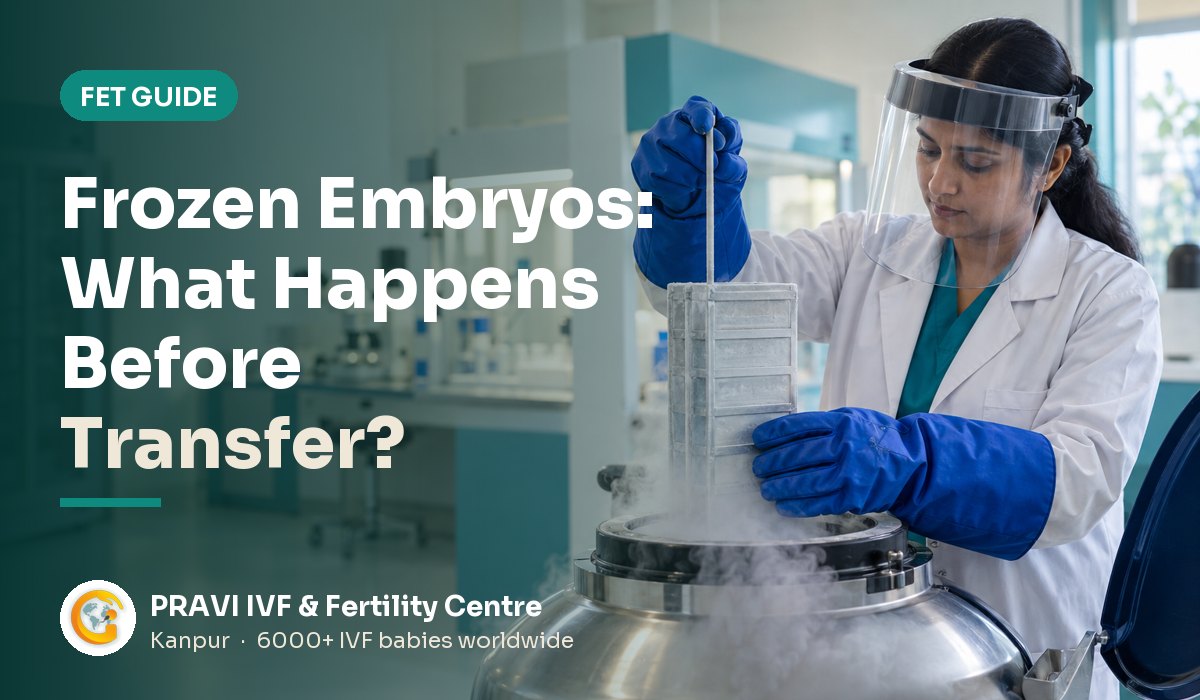
Through an ultra-fast freezing technique called vitrification, these embryos are preserved in liquid nitrogen at -196°C. Vitrification cools the cells so quickly that damaging ice crystals cannot form. The embryos enter a state of complete suspended animation. Weeks, months, or even years later, an embryo is thawed and transferred into the uterus during a carefully timed cycle. You can learn more about how our lab handles this delicate process through our specialized egg and embryo freezing in Kanpur services.
According to clinical data compiled by the NHS, frozen embryo transfers now deliver results that match or often exceed fresh transfers. This is largely because the mother's body is free from the intense hormonal stimulation used during the initial egg retrieval stage.
Why Many Couples Choose FET Over Fresh Transfers
Years ago, fresh transfers were the default standard. Today, advanced reproductive medicine leans heavily toward the "freeze-all" strategy. Couples in Kanpur choose FET for several compelling medical and personal reasons:
- Your Uterine Lining Is More Natural: High doses of fertility medications during egg retrieval can temporarily push estrogen and progesterone to extreme levels. This can make the endometrium (uterine lining) less receptive. FET allows your body to reset, so the embryo enters a calm, naturally primed environment.
- Avoiding Ovarian Hyperstimulation Syndrome (OHSS): Women with Polycystic Ovary Syndrome (PCOS) often produce a large number of eggs. Transferring an embryo immediately increases the risk of severe OHSS. Freezing all embryos eliminates this danger and keeps you safe.
- Time for Genetic Testing (PGT-A): If you need pre-implantation genetic testing to screen for chromosomal conditions, embryos must be biopsied and frozen while the laboratory analyzes the DNA samples.
- Building a Family on Your Timeline: If you get multiple healthy blastocysts from one cycle, freezing preserves your future family plans. You can carry one pregnancy now, and return two or three years later for your second child using your frozen embryos, without repeating ovarian stimulation.
- Medical Treatments: If a patient is diagnosed with cancer or needs urgent pelvic surgery, freezing embryos before therapy protects their chance of having biological children later.
Fresh Transfer vs. Frozen Embryo Transfer (FET)
Patients often ask our specialists how the two approaches compare. Here is a clear breakdown of how fresh and frozen transfers differ in practice:
| Feature | Fresh Embryo Transfer | Frozen Embryo Transfer (FET) |
|---|---|---|
| Timing | 3 to 5 days after egg collection | 4 to 8 weeks (or years) after egg collection |
| Hormone State | Elevated due to ovarian stimulation | Near-natural or gently prepared with oral estrogen |
| OHSS Risk | Moderate to high in high-responder patients | Near zero |
| Genetic Screening | Rarely feasible due to rapid turnaround needed | Easily accommodated while embryos remain vitrified |
| Physical Recovery | Body may feel bloated from retrieval | Body is fully rested and healed |
The Science of Vitrification: How Embryos Stay Safe
At PRAVI IVF, the safety of your embryos rests in the hands of our laboratory team, led by Dr. Rit Shukla, Chief Embryologist. With over a decade of hands-on experience handling micro-gametes, Dr. Shukla oversees strict protocols that ensure our vitrification survival rates remain exceptionally reliable.
Old freezing techniques (slow freezing) carried a small risk of ice crystal formation, which could tear cell walls. Vitrification replaced this entirely. By using specialized cryoprotectant solutions and dropping the temperature instantly, the embryo turns into a glass-like solid. Biological time stops completely. When thawed correctly, the embryo resumes its cell division exactly where it left off, showing no loss in health or developmental potential.
India's fertility care adheres strictly to the legal standards set under the Assisted Reproductive Technology (Regulation) Act, 2021. You can inspect the legal framework on the official India Code ART Act portal, which ensures that embryo storage, consent, and safety parameters follow ethical guidelines nationwide.
Step-by-Step: What to Expect During an FET Cycle
If you and your doctor decide on FET, the process is gentle, straightforward, and generally pain-free. It does not require anesthesia or hospital stays. Here is how the journey looks:
1. Lining Preparation
Your cycle usually begins on Day 2 or Day 3 of your menstrual period. Your fertility specialist, such as Dr. Monica Sachdeva or Dr. Sakshi Tandon, will perform a baseline ultrasound. You will begin taking mild estrogen tablets to help your endometrium grow thick, plush, and multi-layered (trilaminar). In some cases, doctors recommend a "natural cycle FET" where your body's own ovulation primes the lining without extra estrogen.
2. Monitoring Lining Thickness
Over the next 10 to 14 days, you will visit our clinic for two or three brief ultrasound scans. Doctors look for an endometrial thickness between 7 mm and 11 mm. Once your lining reaches this ideal target, progesterone support is added via vaginal capsules or gentle injections. Progesterone switches the lining from growth mode into receptive mode, mimicking the natural luteal phase.
3. Thawing the Embryo
On the scheduled transfer day, Dr. Rit Shukla and our embryology team remove your vitrified embryo from the liquid nitrogen tank. The embryo is placed in warming baths to wash away the protective solutions. Within minutes, the cells rehydrate. The embryologist checks the embryo under high-magnification optics to confirm full viability before clearing it for transfer.
4. The Transfer Procedure
The embryo transfer takes less than 15 minutes. You remain awake and comfortable. Guided by abdominal ultrasound, your doctor passes a very soft, thin catheter through the cervix and deposits the embryo along with a tiny drop of fluid into the middle of your uterine cavity. Most women say it feels no different than a standard routine pelvic exam or Pap smear.
5. The Two-Week Wait
After a short rest at the clinic, you walk out and return home. You will continue taking your prescribed progesterone and other supportive vitamins. About 12 to 14 days later, a simple blood test (Serum Beta-hCG) confirms whether implantation has taken place.
Common Misconceptions About Embryo Freezing
It is completely normal to have doubts when you hear about freezing something as delicate as an embryo. Many couples worry that frozen embryos produce babies with health problems, or that embryos "expire" if left in storage too long. These worries are addressed in detail in our guide on IVF myths vs facts answered by Kanpur doctors.
Extensive studies referenced by organizations like the Mayo Clinic confirm that children born from frozen embryos are just as healthy, developmentally normal, and strong as those conceived naturally or through fresh transfers. In fact, because the mother's uterus is in a calm, non-stimulated hormonal state during FET, some research shows a slightly lower rate of low birth weight and preterm delivery compared to fresh transfers.
Understanding the Cost of FET in Kanpur
Cost transparency is essential for every couple walking through our doors. Because fertility treatment involves several phases, we make sure you receive an itemized, clear breakdown before beginning treatment. We do not believe in hidden fees.
The total cost for Embryo Freezing and FET depends on several individual factors:
- Number of Embryos Vitrified: Laboratories use specialized medical-grade straws to store embryos. The number of straws required influences the initial freezing fee.
- Duration of Cryopreservation: Storage is calculated on an annual maintenance basis. Under Indian ART laws, embryos can be securely stored for defined durations based on your reproductive goals.
- Medication and Monitoring: Ultrasound scans, blood hormone checks (estradiol and progesterone), and the specific brands of hormonal support your body requires.
- Embryo Thawing and Transfer Fee: This covers the embryologist's laboratory preparation, disposable transfer catheters, and ultrasound-guided transfer.
After your initial consultation, our financial counselors provide a detailed, written cost sheet tailored to your medical history. To make parenthood accessible without financial strain, we also guide couples through zero-interest installment plans, detailed in our guide on IVF EMI and finance options in Kanpur.
Why Families Trust PRAVI IVF in Kanpur
Under the clinical direction of Dr. Monica Sachdeva (18 years of specialized reproductive medicine experience), PRAVI IVF combines scientific precision with sincere, heartfelt care. Our team includes Dr. Sakshi Tandon and Dr. Ankita (MRCOG, Fellowship in Reproductive Medicine, Diploma in Minimal Access Surgery), who bring deep clinical expertise to every patient's personalized protocol.
Whether you visit our primary center in Swaroop Nagar or our facility in Shardha Nagar, you receive the same gold-standard embryology lab care. Families traveling from nearby neighborhoods frequently visit our IVF clinic near Azad Nagar, Kanpur, appreciating our accessible location, quiet consultation suites, and dedicated ultrasound facilities.
We treat every embryo with the reverence it deserves. We monitor our storage dewars round the clock with automated temperature sensors and manual liquid nitrogen checks, ensuring your future family remains completely protected.
Take Your Next Step with Confidence
Infertility can feel exhausting, but you do not have to make every decision all at once. Embryo freezing gives you the gift of time—allowing your body to rest, recover, and prepare for pregnancy when conditions are truly at their genuine. If you are exploring embryo freezing or planning a frozen embryo transfer, our experienced medical team is here to walk beside you.
Book your confidential appointment today. Reach out directly to our doctors through our contact page or schedule your initial visit online via our simple appointment booking form. Let us help you take the next step toward holding your baby in your arms.
Frequently asked questions
How long can embryos stay frozen before an FET cycle?
Embryos can remain frozen safely for many years without losing their quality. Because vitrification stops all cellular aging, an embryo thawed after five years has the exact same pregnancy potential as one thawed after two months, subject to legal limits under the Indian ART Act.
Does thawing damage the embryos?
With modern vitrification techniques, the embryo survival rate after thawing is exceptionally high, typically above ninety-five percent. Our experienced embryology team monitors the rehydration process closely under high-magnification microscopes to ensure only healthy, intact blastocysts are selected for transfer.
Is the frozen embryo transfer procedure painful?
No, the FET procedure is virtually painless and feels very similar to a routine pelvic exam. No anesthesia or sedation is required. Your doctor uses a fine, flexible catheter under ultrasound guidance to gently place the embryo into your uterus while you remain awake and comfortable.
How many embryos should be transferred during one FET?
To protect both mother and baby, Indian medical and legal guidelines strongly encourage single embryo transfers (SET) or at most two embryos in specific clinical situations. Transferring a single high-quality blastocyst gives high success rates while preventing the complications associated with triplet or twin pregnancies.
What should I do to prepare my body before a frozen transfer?
Focus on taking your prescribed estrogen and progesterone medications on time, eating balanced home-cooked meals, and staying hydrated. Gentle daily walks are helpful for pelvic blood circulation, but strenuous workouts, smoking, and unapproved over-the-counter painkillers should be avoided.
Can I travel home to Kanpur neighborhoods like Naubasta or Kalyanpur right after transfer?
Yes, you can easily travel home after resting for 15 to 20 minutes at the clinic. Long periods of strict bed rest are not medically necessary and do not increase implantation rates; light, normal daily routines around your home are completely safe.
What happens to our extra frozen embryos if our first FET is successful?
Extra embryos remain safely preserved in our liquid nitrogen cryo-storage tanks. You can use them years later to expand your family, or decide on other legal options in accordance with written consent and the Indian ART Regulation Act.
How much does Embryo Freezing and FET cost in Kanpur?
The cost varies depending on the number of embryos vitrified, laboratory consumables, annual storage duration, and your medication requirements. PRAVI IVF provides an itemized, transparent written estimate during your initial consultation, and we also offer flexible EMI payment assistance.