
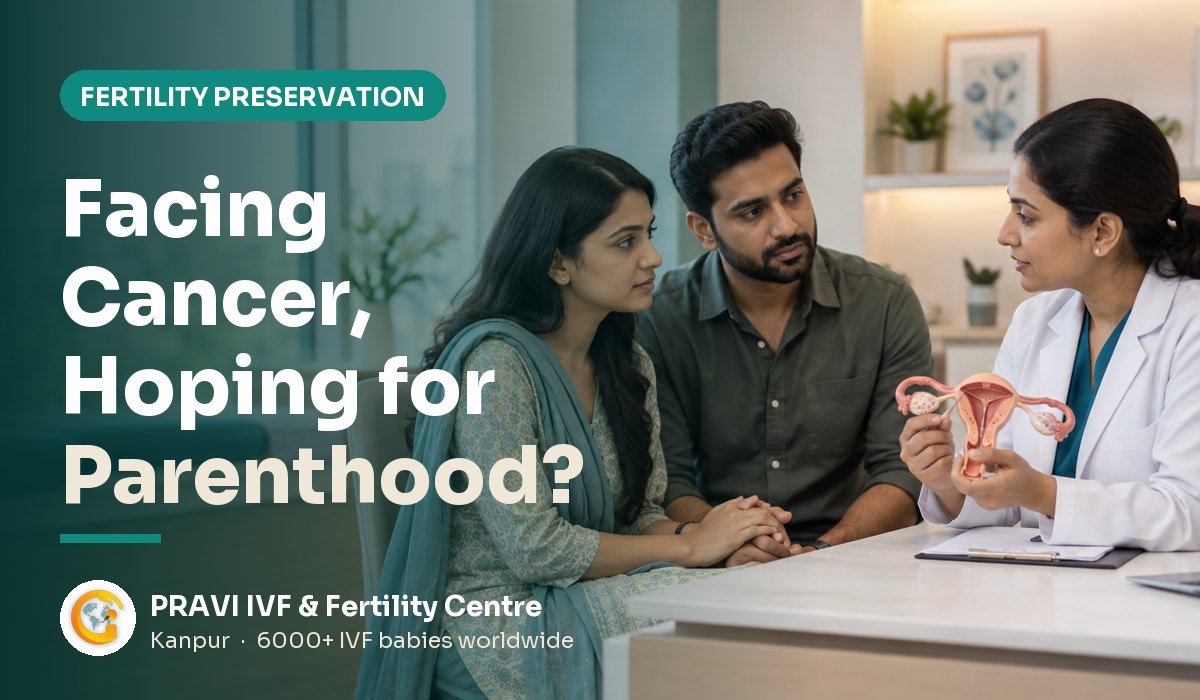
Fertility Preservation for Cancer Patients in Kanpur
Medically reviewed by Dr. Ankita · Updated 12 Oct 2026
A cancer diagnosis is overwhelming, but modern oncofertility can safeguard your dream of having a baby. Learn how PRAVI IVF helps cancer fighters in Kanpur preserve eggs, sperm, and embryos before therapy.
Receiving a cancer diagnosis can make the world come to a sudden halt. In an instant, your calendar fills up with oncologist visits, scans, and urgent treatment plans. During this stressful time, you and your family focus completely on one primary goal: saving your life. That focus is natural and necessary.
Yet, life is much larger than cancer. Thanks to rapid advances in modern oncology, thousands of young men, women, and children beat cancer every single year. They go on to complete their education, build careers, find love, and hope to start families of their own. This is where fertility preservation for cancer patients in Kanpur plays a life-changing role.
Many life-saving treatments, such as chemotherapy, pelvic radiation, and pelvic surgeries, can permanently damage eggs, sperm, and reproductive organs. By having a conversation about fertility before your oncology treatment begins, you keep your future dreams of parenthood alive. At PRAVI IVF & Fertility Centre, our medical team, under the guidance of Medical Director Dr. Monica Sachdeva and reviewed by Dr. Ankita, offers compassionate, fast-tracked care so you never have to sacrifice tomorrow's dreams for today's treatment.
Understanding Oncofertility: Why Cancer Treatments Threaten Fertility
Oncofertility is the medical bridge between cancer therapy and reproductive health. Many people are surprised to learn that standard chemotherapy and radiation can cause temporary or permanent infertility. Understanding how these therapies affect your body can help you take practical steps without delay.
Chemotherapy drugs travel through your bloodstream to attack rapidly dividing cells. While this effectively destroys cancer cells, it also harms healthy cells that divide fast. In men, chemotherapy attacks the dividing germ cells in the testicles that produce sperm. In women, ovaries do not make new eggs; girls are born with a fixed lifetime reserve of eggs. Chemotherapy drugs, especially alkylating agents, can accelerate egg loss or destroy ovarian follicles entirely. This can trigger sudden, premature menopause, sometimes in women in their twenties or thirties.
Radiation therapy poses a similar risk when directed at or near the pelvic region, lower abdomen, spine, or the pituitary gland in the brain. Radiation to the pelvic organs can damage the ovaries and testicles, while uterine radiation may cause scarring that makes it difficult for a woman to carry a pregnancy safely in the future. Furthermore, brain radiation can disrupt hormones like FSH and LH, which signal your body to produce sperm or ovulate. Authoritative resources from ReproductiveFacts.org explain how gonadotoxic treatments directly impair ovarian reserve and spermatogenesis.
The Golden Window: Timing Is Everything
When you are diagnosed with cancer, every day feels urgent. Many patients assume that freezing eggs or sperm will delay their cancer care by months, putting their survival at risk. This is a common misunderstanding that often causes unnecessary regret later.
For men, sperm banking takes only 24 to 48 hours. A sample can be collected and cryopreserved safely in our laboratory within a single afternoon. For women, modern fertility protocols allow us to start ovarian stimulation immediately, regardless of where you are in your menstrual cycle. Known as "random-start stimulation," this process typically takes only 10 to 14 days before egg retrieval. In many clinical situations, your oncologist will already need one to two weeks to run staging scans, biopsy reviews, and insurance approvals. We use that exact window so your cancer therapy starts right on schedule.
Our priority at PRAVI IVF is your health. We never begin any fertility preservation procedure without direct written clearance and close communication with your treating oncologist. With a little himmat (courage) and the right medical coordination, you can protect both your survival and your fertility.
Fertility Preservation Options for Women
Women have several proven options to preserve their fertility depending on their age, relationship status, diagnosis, and the urgency of their oncology plan.
1. Mature Oocyte (Egg) Freezing
Oocyte cryopreservation is the gold standard for single women and young adult girls who have reached puberty. You receive daily hormone injections for approximately 10 to 12 days to stimulate multiple follicles to mature. During this time, our specialists monitor your progress with gentle transvaginal ultrasounds and hormone blood tests. Once the eggs reach maturity, an embryologist and fertility doctor retrieve them under light sedation through a short, needle-guided procedure. There are no surgical incisions. To learn more about how we safeguard mature eggs, explore our dedicated guide to egg and embryo freezing in Kanpur.
2. Embryo Freezing
For married couples or women with a committed partner, embryo freezing offers very high survival and future pregnancy success rates. After the eggs are retrieved, they are immediately fertilized with your partner's sperm in our laboratory using Intracytoplasmic Sperm Injection (ICSI). The resulting embryos are cultured until they reach the blastocyst stage (day 5) and then safely vitrified in liquid nitrogen tanks for long-term storage.
3. Ovarian Transposition (Oophoropexy)
If you need pelvic radiation for conditions like cervical, rectal, or pelvic lymphoma, but do not require heavy chemotherapy, a surgeon can surgically lift your ovaries out of the radiation field. Dr. Ankita, who holds a Diploma in Minimal Access Surgery, can perform this via minimally invasive laparoscopy. The ovaries are moved higher up into the abdominal wall, away from the path of radiation beams, helping shield them from direct radiation damage.
4. Ovarian Suppression with GnRH Agonists
In cases where cancer treatment must start immediately and egg retrieval is not possible, monthly injections of GnRH agonists can be given. These medications temporarily place the ovaries in a quiet, resting state, mimicking menopause. While not a replacement for egg freezing, clinical trials suggest it can offer partial protection against chemotherapy-induced ovarian failure for certain breast cancer and lymphoma patients.
Fertility Preservation Options for Men
Men facing cancer treatments also have straightforward, reliable methods to protect their future ability to have biological children.
1. Semen Cryopreservation
Sperm freezing is non-invasive, quick, and highly effective. We advise men to provide one to three semen samples before starting their very first dose of chemotherapy or pelvic radiation. Even a single round of chemo can cause DNA fragmentation in sperm, so freezing must happen before therapy begins. The samples are analyzed, washed, placed in special cryo-vials, and frozen at -196 degrees Celsius.
2. Surgical Sperm Retrieval (TESA/PESA)
Sometimes, a patient cannot provide a semen sample naturally due to severe pain, weakness, stress, spinal tumors, or neurological side effects. In these cases, our fertility doctors perform Testicular Sperm Aspiration (TESA) or Percutaneous Epididymal Sperm Aspiration (PESA). Using a tiny needle under local anesthesia, mature sperm are collected directly from the testicle and immediately preserved.
Inside the Laboratory: The Science of Ultra-Rapid Vitrification
Preserving reproductive cells requires advanced technology and exceptional laboratory discipline. In the past, clinics used slow-freezing methods that often allowed sharp ice crystals to form inside delicate cells, damaging cell membranes. Today, PRAVI IVF relies on vitrificationâan ultra-rapid freezing process that transforms liquid into a glass-like solid in fractions of a second.
Our lab operations are led by Chief Embryologist Dr. Rit Shukla, who brings over a decade of hands-on experience handling sensitive oncofertility samples. You can read more about how our specialists maintain culture conditions and monitor tanks in our behind-the-scenes article on the embryologist's role in the IVF lab in Kanpur. Every sample is tagged with multiple digital and physical identifiers and stored in monitored liquid nitrogen dewars that remain completely safe even during power disruptions.
| Preservation Method | Ideal Candidate | Timeline Needed | Procedure Type |
|---|---|---|---|
| Sperm Cryopreservation | Post-pubertal adolescent boys and adult men | 1 to 3 days | Non-invasive collection |
| Oocyte (Egg) Freezing | Post-pubertal girls and unmarried adult women | 10 to 14 days | Outpatient transvaginal retrieval |
| Embryo Freezing | Married couples facing cancer treatment | 10 to 14 days | Stimulation, retrieval, ICSI, and vitrification |
| Ovarian Transposition | Women requiring pelvic radiotherapy | Single outpatient surgery | Minimally invasive laparoscopy |
| TESA / PESA | Men unable to ejaculate naturally | Same-day procedure | Minor needle aspiration under local anesthesia |
Navigating the Legal and Safety Rules in India
Patients often wonder how long their frozen reproductive cells can safely stay stored in a clinic. The Government of India has clearly outlined patient protections and ethical laboratory standards under the Assisted Reproductive Technology (Regulation) Act, 2021. You can review the statutory framework on the India Code ART Act portal.
Under these regulations, licensed clinics can store gametes and embryos for registered patients with complete legal security and routine consent renewals. The law ensures your genetic material is tracked with strict bio-vigilance, preventing unauthorized use or accidental destruction. When you are cured, in remission, and cleared by your oncologist to plan a family, your frozen eggs or sperm are thawed carefully. They can then be utilized via IVF or ICSI to help you achieve a healthy pregnancy.
Understanding the Cost Factors
Facing cancer is an emotional and financial burden on families across Uttar Pradesh. We believe in total financial transparency from day one. Because oncofertility needs differ from patient to patient, overall costs vary depending on several individual medical factors:
- Medication dosage: Women require hormone injections for stimulation. Dosages vary based on age, weight, and anti-Müllerian hormone (AMH) levels.
- Procedure complexity: An outpatient egg retrieval or surgical TESA has different facility and equipment needs than standard semen freezing.
- Number of cycles: Some female patients with adequate time and oncologist clearance choose to undergo two quick cycles to freeze a higher number of eggs.
- Annual storage fees: Liquid nitrogen storage requires continuous maintenance, tank monitoring, and regular nitrogen replenishment over the years.
We do not provide flat or misleading estimates over the phone. Instead, our team reviews your oncology timeline, performs initial blood checks, and provides a clear, written cost estimate outlining every phase before any procedure begins.
Why Families in Kanpur Trust PRAVI IVF
Cancer care requires a coordinated team of caring specialists. PRAVI IVF brings genuine-tier reproductive medicine directly to Central Uttar Pradesh. With centers located in Swaroop Nagar and Shardha Nagar, we ensure families across Kanpur and nearby towns do not need to make stressful journeys to metro cities during cancer workups.
Whether you are seeking advice from an IVF doctor near Tilak Nagar, Kanpur or looking for an experienced IVF clinic near Panki, Kanpur, our doors are open with urgent priority appointments for cancer patients. Our clinical team, featuring Dr. Monica Sachdeva, Dr. Ankita, and Dr. Sakshi Tandon, collaborates directly with leading oncologists across Kanpur and Lucknow to ensure your safety comes first at every step.
If you or your loved one has just received a cancer diagnosis and hasn't started therapy yet, time is critical. Reach out to our compassionate team through our contact page or book a fast-track consultation today. We are here to stand beside you, provide genuine umeed (hope), and protect your future family.
Frequently asked questions
Will freezing my eggs or sperm delay my cancer treatment?
For men, sperm freezing takes only one to two days and never delays oncology therapy. For women, modern 'random-start' stimulation protocols take about 10 to 14 days, which almost always fits smoothly inside the time needed for cancer staging, biopsy evaluations, and pre-treatment planning.
Is ovarian stimulation safe for women with hormone-sensitive cancers like breast cancer?
Yes, it can be done safely using specialized protocols. In patients with estrogen-receptor-positive breast cancers, doctors co-administer medications like letrozole (an aromatase inhibitor) alongside stimulation hormones to keep blood estrogen levels within safe limits throughout the cycle.
Can chemotherapy damage sperm if I wait until after my first round to freeze?
Yes, even a single round of chemotherapy or radiation can cause severe DNA fragmentation in developing sperm cells. That is why it is strongly recommended to complete sperm banking before your very first chemotherapy infusion or radiation session.
How long can frozen eggs, sperm, or embryos stay stored at PRAVI IVF?
Reproductive cells stored in liquid nitrogen at -196 degrees Celsius do not degrade biologically over time. Under the Indian ART (Regulation) Act, 2021, gametes and embryos can remain cryopreserved safely for years, ready to be thawed whenever you are medically cleared to start your family.
What happens if a male cancer patient is unable to produce a semen sample naturally?
When physical illness, severe stress, pain, or nerve issues prevent natural collection, our specialists can perform quick surgical sperm retrieval techniques such as TESA or PESA. These minor outpatient procedures extract sperm directly from testicular tissue under local anesthesia.
Does fertility preservation guarantee a baby after cancer recovery?
While no medical procedure can promise a 100% guarantee, modern vitrification offers a high success rate for cell survival and future fertilization. Your long-term outcome depends on the number and quality of eggs or sperm frozen, your age at the time of freezing, and your general uterine health after cancer therapy.
Can young children or pre-pubertal teenagers preserve their fertility before cancer therapy?
Post-pubertal adolescents can freeze mature sperm or eggs just like adults. For pre-pubertal children who do not yet produce mature gametes, experimental methods like ovarian or testicular tissue cryopreservation are studied globally, though adult options like sperm and egg banking remain the standard proven paths.
How much does fertility preservation for cancer patients cost in Kanpur?
Costs depend on medication requirements, the specific procedure chosen (sperm freezing, egg retrieval, or embryo freezing), and annual maintenance fees for liquid nitrogen storage. PRAVI IVF reviews your specific clinical needs with your oncologist and provides a transparent, written cost estimate before you begin.