
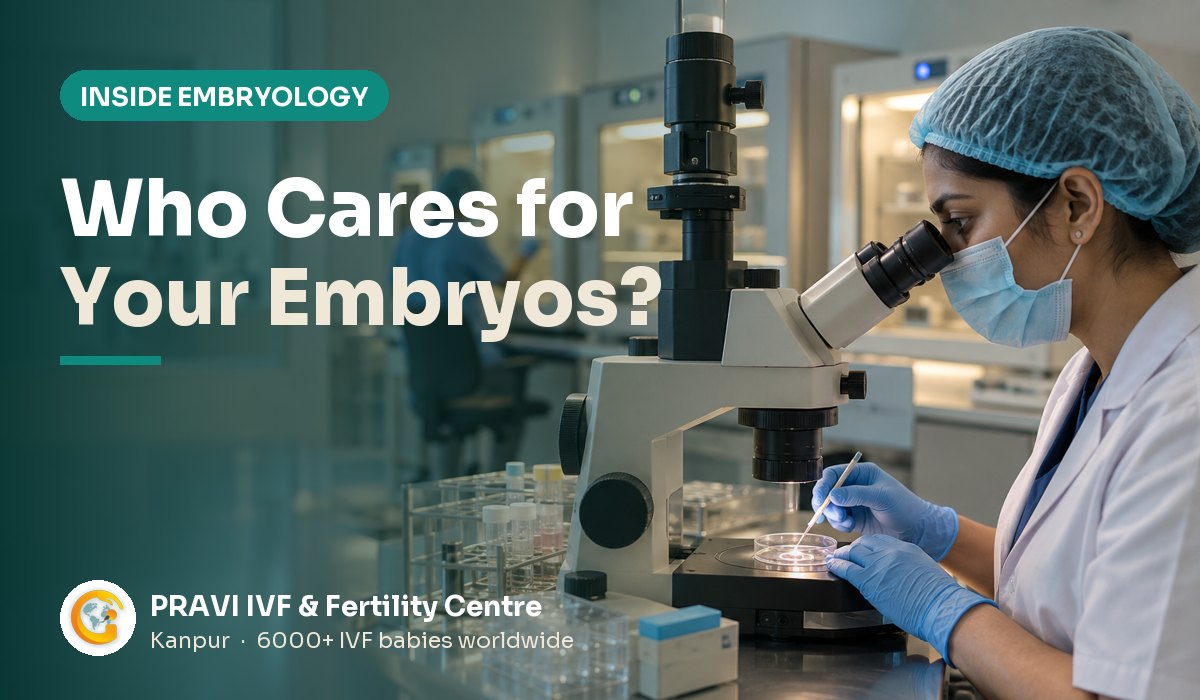
Embryologist's Role in IVF: Inside the PRAVI Lab, Kanpur
Medically reviewed by Dr. Rit Shukla · Updated 12 Oct 2026
Discover the crucial role an embryologist plays during IVF. Step inside the state-of-the-art PRAVI laboratory in Kanpur to see how your embryos are protected, nourished, and graded.
When you start your fertility journey, you spend most of your clinic visits talking with your doctor. You discuss blood tests, ultrasound scans, and daily injections. But after your egg pickup procedure, a quiet miracle begins behind a secure, double-sealed door. This is where the embryologist takes charge of your future baby's first few days of life.
Many couples wonder what actually happens to their eggs and sperm once they leave the procedure room. The embryologist's role in IVF is both a delicate science and an art. In simple words, the embryologist acts as your baby's first babysitter, guardian, and scientist. At PRAVI IVF & Fertility Centre in Kanpur, our lab team works around the clock in cleanroom environments to give your embryos the safest start possible.
Who Is an Embryologist and Why Are They Vital?
An embryologist is a specialized medical scientist trained in reproductive biology. While fertility doctors care for the hopeful parents, embryologists care directly for the eggs, sperm, and developing embryos. Their hands carry out the delicate steps that turn gametes into healthy blastocysts.
Our embryology team at PRAVI is led by Dr. Rit Shukla, Chief Embryologist with over a decade of dedicated laboratory experience. Working closely alongside Medical Director Dr. Monica Sachdeva, who brings over 18 years of experience in reproductive medicine, the lab team ensures that your cells are treated with utmost precision and dignity.
If you are exploring IVF in Kanpur, understanding this quiet work can give you deep peace of mind. When doctors extract eggs, those fragile cells cannot defend themselves against room temperature, harsh room lights, or airborne dust. The embryologist creates an artificial womb that mimics the human fallopian tube and uterus with total accuracy.
Behind the Scenes: Inside the PRAVI IVF Lab in Kanpur
Our laboratory at PRAVI IVF (located conveniently for couples across Swaroop Nagar and Shardha Nagar) is designed like an advanced operating theatre combined with an ultra-clean micro-environment. A small speck of dust or a microscopic chemical fume in normal city air can harm an embryo. That is why strict lab safety is non-negotiable.
Here is what keeps the lab environment safe for your embryos:
- Advanced Air Handling Units (AHU): The air inside our lab passes through high-efficiency particulate air (HEPA) filters and activated carbon filters. This removes volatile organic compounds (VOCs) that can stop cell division.
- Strict Temperature & Gas Control: Embryos grow genuine at exactly 37 degrees Celsius, surrounded by precise mixes of medical-grade carbon dioxide and low oxygen. Our benchtop incubators mimic natural body conditions without temperature drops.
- Low Ambient Lighting: Sunlight and harsh white lights stress human eggs. Our lab uses soft, filtered light so the cells remain calm and unstressed, just like they would inside the human body.
- Triple Identity Matching: Every dish, tube, and slide carries verified barcodes and labels. Two embryologists verify your identity at every single milestone under strict guidelines set by the Indian Council of Medical Research (ICMR).
Day 0 to Day 5: The Embryologist's Daily Journey with Your Cells
From the hour your eggs are retrieved to the morning of your embryo transfer, the embryologist follows a detailed hourly protocol. Here is what happens day by day inside the PRAVI laboratory.
Day 0: The Retrieval and the Union
Egg collection happens in the adjacent procedure suite. Dr. Sakshi Tandon or Dr. Ankita gently collects the follicular fluid and passes it through a heated window hatch directly into the embryology lab. The embryologist searches through the fluid under a stereomicroscope to spot and isolate every mature egg.
Meanwhile, the partner's semen sample is prepared. The embryologist washes away seminal fluid, debris, and immobile sperm, selecting only the fastest, most normally shaped swimmers. Depending on your treatment plan, the embryologist either carries out conventional IVF or Intracytoplasmic Sperm Injection (ICSI).
During ICSI, Dr. Rit Shukla uses a high-powered inverted microscope with tiny glass needles. He holds a single egg with gentle suction, picks up a single healthy sperm, and carefully injects it into the centre of the egg. This requires steady hands, deep patience, and years of muscle memory.
Day 1: Checking for Fertilization
Approximately 16 to 18 hours after insemination, the embryologist checks the dishes. They look for two tiny circles inside the egg called pronuclei (2PN). One circle comes from the mother's egg, and one comes from the father's sperm. Seeing two pronuclei confirms that normal fertilization has taken place.
Couples often wait anxiously at home on this day. We understand that feeling of "sab theek hoga na?" (will everything be okay?). Getting that Day 1 phone call with your fertilization report brings an immense sigh of relief.
Day 2 and Day 3: Cleavage Stage Assessment
On Day 2, a fertilized egg should divide into 2 to 4 cells. By Day 3, it should reach 6 to 8 cells. The embryologist checks not just the cell count, but also their symmetry and whether there are tiny fragments breaking off.
Good quality embryos show even cell division with minimal fragmentation. The embryologist logs these details in your laboratory file. If an embryo shows slower growth, they watch it carefully without disturbing its resting environment unnecessarily.
Day 4: The Morula Stage
On the fourth day, the cells begin to touch, compact, and fuse together. The embryo looks like a small mulberry, which is called a morula. The individual cell borders disappear as the embryo prepares for its most demanding transition: becoming a blastocyst.
Day 5: Blastocyst Stage and Grading
By Day 5 (or sometimes Day 6), the embryo has developed into a blastocyst with over 100 cells. It now has two distinct parts: the Inner Cell Mass (which forms the baby) and the Trophectoderm (which forms the placenta).
The embryologist grades the blastocyst using international scoring systems like the Gardner system. A blastocyst graded as 4AA or 5AA is well-expanded with tightly packed cells. The higher the quality of the blastocyst, the higher the chance of a successful pregnancy according to global guidelines from organizations like the American Society for Reproductive Medicine.
Standard Lab Care vs. Advanced Embryology Care at PRAVI
Not every IVF lab operates with the same level of micro-monitoring. Here is a clear comparison of what makes the embryology workflow at PRAVI stand out:
| Care Parameter | Standard Basic Lab | PRAVI Advanced Lab (Kanpur) |
|---|---|---|
| Incubator Style | Large shared box incubators opened frequently | Individual benchtop mini-chambers with rapid gas recovery |
| Air Quality | Basic room filtration | Dedicated Class 10,000 cleanroom with VOC & HEPA carbon filtration |
| Insemination Technique | Standard IVF or basic ICSI | High-magnification ICSI, PESA/TESA sperm processing, laser-assisted hatching |
| Embryo Culture | Day 3 cleavage transfer default | Extended culture to Day 5/6 Blastocyst stage |
| Vitrification Protocol | Slow manual freezing | Ultra-rapid vitrification with near 100% post-thaw survival |
Handling Tough Cases: Low AMH, Male Factor, and Thin Lining
Infertility rarely follows a single straight path. Many couples visiting our Kanpur centre have experienced failed cycles elsewhere or come to us with challenging diagnoses.
For women struggling with diminished ovarian reserve, our team creates tailored protocols. We often begin with an Low AMH Treatment in Kanpur, focusing on egg quality rather than sheer numbers. In low egg count cases, the embryologist cannot afford a single error. Each egg retrieved is precious gold, handled with specialized gentle holding pipettes to protect the fragile outer shell (zona pellucida).
Similarly, when a male partner has very few sperm or severe structural abnormalities, our embryologists spend hours scanning through prepared slides to find viable sperm cells. In cases where sperm must be retrieved directly from the testicles via PESA or TESA, Dr. Rit Shukla isolates viable sperm even when none appear in routine semen analysis.
Meanwhile, our clinical team works hand-in-hand with the lab. While embryos grow safely in their incubators, Dr. Sakshi Tandon or Dr. Ankita may recommend Thin Endometrium Treatment in Kanpur to make sure the uterine bed is thick and receptive before any frozen embryo transfer (FET) takes place.
The Critical Role of Vitrification (Freezing)
Twenty years ago, freezing embryos was slow and carried risks of ice crystal formation that could damage cell walls. Today, the embryologist's role in IVF includes the art of vitrification, an ultra-fast flash-freezing technique.
The embryologist dehydrates the embryo using specialized cryoprotectant liquids and plunges it into liquid nitrogen at minus 196 degrees Celsius within fractions of a second. The embryo instantly turns into a glass-like solid without damaging ice crystals. According to clinical data published by the NHS, frozen embryo transfers have success rates equal to or often higher than fresh transfers because the mother's body has had time to recover from stimulation hormones.
When you are ready for your transfer, the embryologist warms the embryo in warming baths within minutes. At PRAVI, our post-thaw survival rates are consistently high, allowing couples to preserve extra embryos for future siblings.
Serving Families Across Kanpur and Neighbouring Districts
Kanpur is an important healthcare hub for central Uttar Pradesh. We frequently see patients visiting our Swaroop Nagar centre who were searching for an IVF Centre near Vikas Nagar, Kanpur, Kakadeo, or Civil Lines. We also welcome families travelling from nearby towns such as Unnao, Fatehpur, and Farrukhabad.
We know how much effort and travel is involved for families coming from district areas. Our embryologists plan lab timings meticulously so that couples travelling for egg pickups or embryo transfers never face unnecessary delays or repeated trips.
Understanding IVF Costs and Ethical Transparency
A big concern for every family is the cost of fertility care. The technical equipment used in an advanced embryology labâsuch as inverted microscopes, micromanipulators, laser hatching systems, and ultra-pure culture mediaârepresents substantial medical investment.
Total treatment costs depend on several personalized factors:
- Whether your cycle requires conventional IVF or advanced ICSI
- The number of culture days (cleavage stage vs. extended blastocyst culture)
- Whether advanced genetic testing like PGT-A is required
- The number of embryo straws frozen and the storage duration
- Need for additional procedures like TESA, PESA, or laser-assisted hatching
At PRAVI IVF, we do not believe in hidden costs or package surprises. Every couple receives a transparent, written financial estimate after their medical consultation, outlining every clinical and laboratory fee clearly before treatment begins.
Meet the Medical Minds Behind PRAVI's Lab
Great laboratory science requires close collaboration between the clinical doctors and the embryologist. At PRAVI IVF, our leadership combines decades of local and international clinical expertise:
- Dr. Monica Sachdeva (Medical Director): With over 18 years in reproductive medicine, she designs gentle, patient-specific stimulation protocols that yield mature, healthy eggs for the lab.
- Dr. Rit Shukla (Chief Embryologist): With 10 years of laboratory mastery, he oversees every culture dish, ICSI procedure, and cryopreservation protocol in our Kanpur lab.
- Dr. Sakshi Tandon (Gynaecologist & Fertility Specialist): Specializing in reproductive endocrinology and patient counseling, she ensures patients feel supported throughout their cycles.
- Dr. Ankita (Fertility Specialist & Surgeon): Holding an MRCOG, a Fellowship in Reproductive Medicine, and a Diploma in Minimal Access Surgery with over 6 years of experience, she expertly manages complex hysteroscopic and laparoscopic corrections.
This team talks every single day. If your embryo is dividing at a certain pace, your doctor knows about it within minutes. That seamless link between the doctor's consultation room and the embryologist's workstation is what delivers high success rates and safe outcomes.
Your Next Step Toward Parenthood
Stepping into an IVF clinic can feel overwhelming, but you do not have to carry that worry alone. Behind every successful pregnancy test at PRAVI is an embryologist who watched your embryo take its very first breath in culture media. If you are ready to understand your fertility options and see how modern embryology can help your family grow, we invite you to take the first step. Please book an appointment online or reach out to us directly through our contact page to speak with our caring specialists today.
Frequently asked questions
What is the primary role of an embryologist in an IVF cycle?
An embryologist is responsible for handling, evaluating, and caring for eggs, sperm, and embryos. They perform fertilization procedures like ICSI, monitor embryo development in incubators, grade blastocysts, and carry out freezing and thawing.
Does the embryologist choose which embryo to transfer?
The embryologist evaluates embryo quality based on cell count, symmetry, and blastocyst expansion. They recommend the highest-quality embryo, and together with your fertility doctor, decide the genuine one for transfer.
How does an embryologist ensure eggs and sperm don't get mixed up?
At PRAVI IVF, we follow strict double-witnessing and barcoding protocols aligned with ICMR guidelines. Two embryologists independently verify patient IDs on every dish, tube, and cryo-straw before any procedure occurs.
What is the difference between Day 3 and Day 5 embryo culture?
On Day 3, an embryo is at the cleavage stage with about 6 to 8 cells. By Day 5, it reaches the blastocyst stage with over 100 cells. Blastocysts have a higher implantation potential, allowing our embryologists to select the healthiest embryo.
Can an embryologist fix a poor quality egg or sperm?
An embryologist cannot alter the biological genetics of an egg or sperm, but they use advanced techniques like ICSI and laser hatching to give fragile gametes the genuine possible chance to fertilize and develop.
Why is air quality inside the embryology lab so strictly controlled?
Human embryos have no immune defense against microscopic airborne toxins, bacteria, or volatile organic compounds (VOCs). Cleanroom HEPA and carbon filters maintain an environment pure enough for fragile cells to survive.
What happens during the embryo thawing process?
The embryologist carefully warms the vitrified embryo through a series of temperature-controlled warming baths. This safely removes the cryoprotectant solution and rehydrates the embryo, achieving high survival rates.
Can patients speak directly to the embryologist at PRAVI IVF Kanpur?
Yes. At PRAVI IVF, Chief Embryologist Dr. Rit Shukla and our clinical team regularly update patients on their fertilization status, embryo grading, and freezing reports so families feel informed and reassured.