
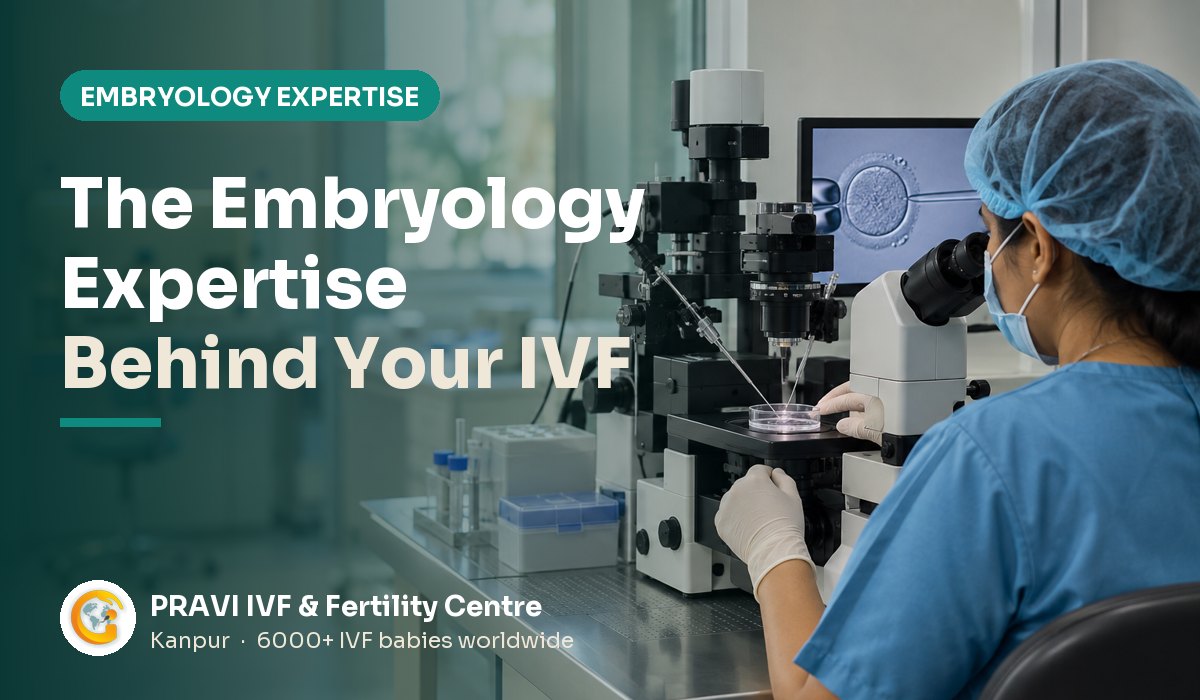
Dr. Rit Shukla: Embryology & Fertility Expertise in Kanpur
Medically reviewed by Dr. Rit Shukla · Updated 12 Oct 2026
Learn how Chief Embryologist Dr. Rit Shukla combines over a decade of laboratory expertise with compassionate care to help couples build their families at PRAVI IVF in Kanpur.
When you start an IVF journey, you will spend plenty of time talking with your fertility doctor. You will talk about your menstrual cycles, your hormone levels, and your ultrasound scans. But there is another crucial person working quietly behind the scenes to help create your baby. That person is the embryologist.
In Kanpur, families hoping to welcome a child often place their trust in Dr. Rit Shukla. As the Chief Embryologist at PRAVI IVF & Fertility Centre, Dr. Rit brings over 10 years of hands-on laboratory experience to every cycle. While you rest in the recovery room after egg retrieval, Dr. Rit is in the cleanroom laboratory, carefully handling your eggs, sperm, and developing embryos.
Understanding what happens in the embryology lab can take away much of the fear around fertility treatments. When you know who is handling your cells and how they are protected, you can move forward with peace of mind and genuine hope.
Who Is an Embryologist and Why Do They Matter?
Many patients ask, “Doctor, what does an embryologist actually do?” In simple terms, an embryologist is the scientist who cares for your future baby during its first few days of life outside the body. According to the World Health Organization (WHO), millions of people worldwide experience infertility. Overcoming these biological hurdles often requires delicate micromanipulation that only a trained embryologist can perform.
An embryologist works in a high-tech cleanroom where air purity, temperature, and light are strictly managed. Human eggs and embryos have no protective immune system. They cannot speak or defend themselves. If the room is slightly too cold or the incubator gas mix changes by a tiny fraction, embryo growth can stall.
This is why the skill of Dr. Rit Shukla matters so much. A great embryologist does not just push buttons on machines. They use steady hands, sharp eyes, and years of intuition to give fragile embryos the genuine chance to thrive. In our culture, we often say that parenthood takes a village. In modern medicine, that village begins in the embryology lab.
Inside the Embryology Lab: What Happens Day by Day?
Patients often feel nervous during the “waiting days” between egg retrieval and embryo transfer. Let us walk through what happens behind those closed lab doors under the supervision of Dr. Rit Shukla.
Day 0: The Retrieval and Insemination
Once the clinical team retrieves the eggs, they hand the fluid directly through a sterile pass-box into the lab. Dr. Rit quickly checks the follicular fluid under a microscope to locate every mature egg. The eggs are then rinsed and placed into an incubator that mimics the natural warmth and pH of the mother’s body.
On the same morning, the semen sample is prepared. The healthiest, fastest-moving sperm are separated from the rest. Depending on your treatment plan, the team performs conventional IVF or advanced ICSI in Kanpur. With ICSI (intracytoplasmic sperm injection), Dr. Rit picks up a single healthy sperm with a microscopic glass needle and gently injects it directly into the center of a mature egg.
Day 1: Checking for Fertilization
Around 16 to 18 hours later, the embryologist checks the eggs. Dr. Rit looks for two small circles called pronuclei inside the egg. One comes from the mother, and one comes from the father. Seeing two pronuclei confirms normal fertilization. This is the moment a couple receives the joyful update that their embryos have officially begun their journey.
Days 2 and 3: The Cleavage Stage
The fertilized eggs begin to divide. By Day 2, a strong embryo usually has 2 to 4 cells. By Day 3, it should reach 6 to 8 cells. Dr. Rit carefully assesses each embryo for symmetry, shape, and fragmentation. Fragmentation refers to tiny pieces of cell debris that can break off during cell division. Low fragmentation generally signals higher embryo quality.
Days 5 and 6: Blastocyst Culture
In the past, clinics often transferred embryos on Day 3. Today, Dr. Rit Shukla focuses heavily on blastocyst culture. By Day 5 or Day 6, an embryo grows to over 100 cells and forms two distinct parts: one that becomes the baby, and one that becomes the placenta. Reaching the blastocyst stage proves that an embryo has the energy and genetic drive to continue growing. Selecting a healthy blastocyst allows for single-embryo transfers, which lowers the risk of multiple pregnancies while maintaining a high success rate.
Specialized Embryology Techniques Offered by Dr. Rit Shukla
Fertility care is not one-size-fits-all. Every couple faces unique biological hurdles. Under the laboratory leadership of Dr. Rit Shukla, PRAVI IVF provides several advanced embryology techniques to address complex fertility challenges.
- Intracytoplasmic Sperm Injection (ICSI): Critical for overcoming low motility, abnormal morphology, or low sperm count.
- Physiological ICSI (PICSI): A technique that selects mature sperm based on their ability to bind to hyaluronan, mimicking natural selection in the body.
- Surgical Sperm Retrieval Handling: Skillful isolation of viable sperm from TESA or PESA samples when there is no sperm in the ejaculate. Couples struggling with this condition can explore low sperm count treatment in Kanpur for targeted solutions.
- Vitrification (Ultra-Rapid Freezing): Freezing eggs, sperm, and blastocysts at minus 196 degrees Celsius in liquid nitrogen without forming damaging ice crystals.
- Laser-Assisted Hatching: Creating a tiny opening in the embryo’s outer shell (the zona pellucida) using a gentle medical laser to help it implant in the uterine wall.
- Preimplantation Genetic Testing (PGT-A): Taking a tiny biopsy of 4 to 5 cells from the placenta part of a blastocyst to check for chromosomal balance before transfer.
| Laboratory Procedure | Primary Purpose | Who Needs It Most? |
|---|---|---|
| Standard IVF | Allows sperm to naturally fertilize the egg in a petri dish. | Couples with normal sperm parameters and tubal issues. |
| ICSI | Injects a single picked sperm straight into the mature egg. | Severe male factor infertility or previous low fertilization. |
| Blastocyst Culture | Grows embryos to Day 5 or Day 6 before transfer. | Couples wanting higher implantation chances and single transfers. |
| Vitrification | Safely freezes surplus embryos or eggs for future years. | Patients avoiding hyperstimulation, banking eggs, or planning frozen embryo transfers (FET). |
| PGT-A Biopsy | Screens embryo chromosomes before putting them in the womb. | Advanced maternal age, recurrent miscarriages, or repeated IVF failure. |
Strict Quality Standards and Legal Protections
An embryology lab must maintain absolute purity. Even common perfumes, deodorants, or cleaning chemicals can release volatile organic compounds (VOCs) that kill delicate embryos. Under Dr. Rit Shukla’s watchful eye, the lab at PRAVI IVF runs with medical-grade HEPA filters, positive pressure air systems, and continuous gas monitoring.
We also follow strict legal and ethical benchmarks. In India, fertility treatments are governed by the Assisted Reproductive Technology (Regulation) Act, detailed by the Ministry of Law and Justice (ART Act). This law protects prospective parents and unborn children. It requires proper double-witness witnessing systems, safe storage protocols, and transparent counseling.
At PRAVI IVF, every single dish, tube, and vial carrying patient cells is double-checked by two specialists before any procedure begins. There is zero room for error. We treat your genetic material with the same respect and devotion as if it were our own family’s future.
The Clinical Team Behind Your Care
Great laboratory work needs an equally strong clinical team to succeed. An embryologist cannot work in isolation; they need high-quality eggs and a healthy, receptive endometrium prepared by experienced doctors. According to the Mayo Clinic's guide to IVF, successful treatment depends on close synchronization between medical ovarian stimulation and laboratory timing.
At PRAVI IVF, Dr. Rit Shukla works side by side with seasoned fertility physicians:
- Dr. Monica Sachdeva: Our Medical Director brings over 18 years of specialized experience in IVF and reproductive medicine, personally guiding complex cycles and poor-responder cases.
- Dr. Sakshi Tandon: A dedicated gynaecologist and fertility doctor who helps couples diagnose subtle reproductive conditions. Learn more about her clinical work through Dr. Sakshi Tandon: Gynaecologist & IVF Doctor in Kanpur.
- Dr. Ankita: Holding MRCOG, a Fellowship in Reproductive Medicine, and a Diploma in Minimal Access Surgery, Dr. Ankita offers over 6 years of focused surgical and reproductive expertise.
Every morning, our embryologists and gynaecologists meet to review ongoing patient cycles. They look at blood hormone levels, ultrasound follicle counts, and embryo pictures together. This complete teamwork ensures that your clinical care and your lab care are always in perfect harmony.
Convenient Care for Busy Families in Kanpur
Undergoing fertility care can feel like a full-time job. Many women worry about missing work or explaining frequent clinic visits to their employers. We have structured our centers in Kanpur—located conveniently at Swaroop Nagar and Shardha Nagar—to offer smooth, stress-free care. Our Delhi location, Pravi Global IVF Polyclinic at 41 Lajpat Nagar, extends this same standard to families in the capital.
If you are managing career demands while trying to conceive, you are not alone. You can read our practical guide on working women IVF planning in Kanpur to learn how flexible appointment timings, organized follicular scans, and pre-scheduled procedures make balancing work and treatment entirely doable.
Understanding Success and Costs Realistically
When couples meet Dr. Rit Shukla and our doctors, their first questions are usually about success rates and price. We believe in complete honesty from day one. In biology, no honest doctor can ever guarantee a 100% result. Success depends on your age, egg reserve, sperm health, uterine lining, and general health.
What we do guarantee is a high success rate built on precision laboratory science. By keeping incubation conditions flawless and freezing only robust blastocysts, Dr. Rit maximizes the potential of every single egg retrieved. Even when initial attempts at other clinics have failed, careful lab adjustments can make the vital difference.
Regarding costs, we avoid misleading package deals or hidden charges. IVF treatment costs vary because every body requires different medications, stimulation protocols, and lab procedures like ICSI or blastocyst freezing. After your initial consultation, ultrasound, and semen assessment, our team provides a clear, transparent written estimate. You will know exactly what each step involves before any treatment begins.
A Compassionate Hand on Your Journey
Experiencing infertility can feel deeply lonely. In our Indian homes, social gatherings and family festivals often come with quiet questions like “Koi khushkhabri hai?” These questions can sting, even when asked with affection. Please know that facing trouble conceiving is not a fault or a failure. Infertility is simply a medical condition that needs the right medical care.
With dedicated scientists like Dr. Rit Shukla watching over your embryos and our caring clinical doctors guiding your treatment, you are in safe, capable hands. We are here to listen to your worries, answer your laboratory questions, and guide you with both advanced science and genuine warmth.
Your path toward holding your baby begins with a single conversation. We invite you to reach out, meet our team, and explore your fertility options with clarity and confidence. Please schedule your appointment or get in touch through our contact page to visit our Swaroop Nagar or Shardha Nagar centers today.
Frequently asked questions
What is the role of Dr. Rit Shukla during an IVF cycle?
Dr. Rit Shukla is the Chief Embryologist who manages the laboratory stages of your IVF cycle. He inspects retrieved eggs, prepares sperm samples, performs delicate micromanipulation like ICSI, monitors embryo division, and vitrifies blastocysts for future transfers.
How does Dr. Rit Shukla decide between Day 3 and Day 5 embryo transfer?
Dr. Rit evaluates the number, division rate, and cellular symmetry of your embryos. Growing embryos to Day 5 (blastocyst stage) allows natural selection to identify the hardiest embryos, which supports single embryo transfer and maintains a high success rate.
Can Dr. Rit Shukla help if the male partner has zero sperm in the ejaculate?
Yes. When sperm cannot be found in the ejaculate (azoospermia), our surgical team can retrieve sperm directly from the testicles via TESA or PESA. Dr. Rit then isolates viable sperm under high magnification to fertilize the eggs using ICSI.
Why is laboratory air quality so important in embryology?
Embryos are extremely sensitive to microscopic dust, bacteria, and volatile organic compounds (VOCs). Dr. Rit oversees a positive-pressure cleanroom with multi-stage HEPA filtration to ensure the air is pure, protecting your embryos from environmental stress.
What happens if an embryo is frozen at PRAVI IVF?
Embryos are frozen using vitrification, an ultra-rapid cooling method that solidifies cells without forming harmful ice crystals. Dr. Rit stores these embryos in liquid nitrogen tanks at minus 196 degrees Celsius, where they remain safely preserved for years.
Where can patients meet Dr. Rit Shukla and the PRAVI IVF team in Kanpur?
Patients can visit PRAVI IVF & Fertility Centre at our Swaroop Nagar and Shardha Nagar branches in Kanpur, Uttar Pradesh. We also have a polyclinic located at 41 Lajpat Nagar in New Delhi.
How much does IVF or ICSI cost with Dr. Rit Shukla?
Fertility treatment costs vary based on medication requirements, egg reserve, and the specialized lab procedures you need. PRAVI IVF provides a transparent, personalized written cost estimate after your initial clinical consultation and assessment.
Is genetic testing of embryos (PGT-A) performed by the embryology team?
Yes, Dr. Rit Shukla performs the delicate biopsy on Day 5 or Day 6 blastocysts. A few cells are carefully removed from the outer trophectoderm layer and screened for chromosomal health before an embryo is selected for transfer.