
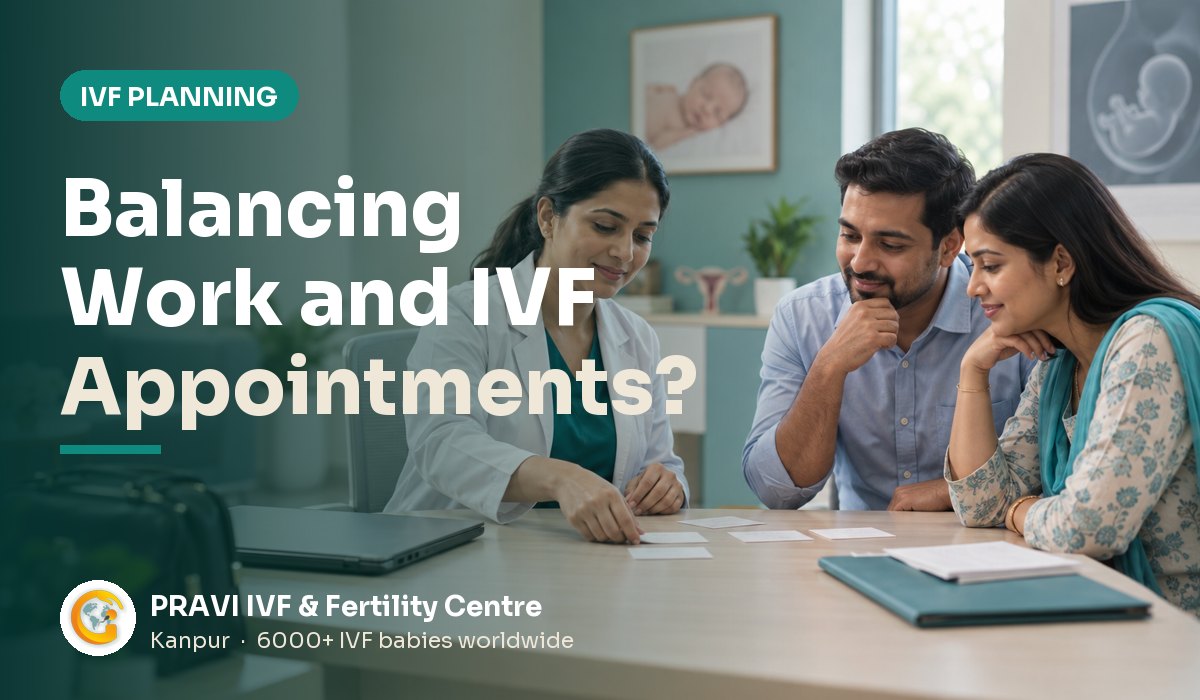
Working Women & IVF Planning in Kanpur
Medically reviewed by Dr. Monica Sachdeva · Updated 5 Oct 2026
A practical guide for working women in Kanpur on how to balance busy workdays, meetings, and clinic visits during an IVF cycle without compromising career goals.
Balancing a demanding job with fertility treatment often feels like juggling two full-time roles at once. Between early morning team scrums, client deadlines, and business travel, adding daily injections and frequent clinic visits can feel overwhelming. Many working women in Kanpur wonder if they must put their hard-earned careers on hold to build a family. The short answer is no. With thoughtful planning, clear communication, and the right clinical partner, you can smoothly navigate both paths.
At PRAVI IVF & Fertility Centre, we meet bankers, civil servants, software engineers, teachers, and entrepreneurs every week. Most share the exact same worry: "How will I manage the appointments without telling everyone at the office?" Taking control of your fertility journey does not require stepping away from your ambitions. Understanding what happens at each stage helps you plan your work calendar with confidence and peace of mind.
Why IVF Planning Demands Special Attention from Working Women
An IVF cycle relies on your natural biological clock, not your work calendar. Unlike routine healthcare visits that you can push to the weekend, fertility cycles depend heavily on hormonal surges and follicle growth. When an egg is ready, it must be retrieved within a strict window of time. Missing a scan or taking a trigger shot two hours late can change your entire cycle outcome.
Kanpur is an active, industrious city. Whether you commute across the Ganges from Unnao, work in the commercial zones of Civil Lines, or teach near Kalyanpur, traffic delays and sudden meetings are real parts of your day. Adding clinical visits to this routine requires strategic scheduling. Choosing a centre with flexible morning slots and rapid ultrasound facilities makes all the difference between a calm day and constant stress.
The Core IVF Timeline: What It Truly Demands from Your Schedule
Many women imagine that IVF requires weeks of strict bed rest. In reality, modern fertility medicine encourages you to stay active and stick to your daily routine. Let us break down the standard phases of IVF treatment in Kanpur so you know exactly which days require your physical presence and which can be managed remotely.
Phase 1: Diagnostic Workup and Ovarian Reserve Testing
Your journey begins with diagnostic baseline assessments. This phase usually happens during the first few days of your menstrual cycle. It involves a simple pelvic ultrasound and routine blood panels to measure hormones like FSH, LH, and estradiol. You will also undergo an AMH test in Kanpur, which tells your specialist about your current egg reserve.
These visits take very little time. A blood draw takes five minutes, and a transvaginal scan takes about ten to fifteen minutes. Most working women complete these early morning visits before 9:00 AM and head straight to their workplaces without taking any leave.
Phase 2: Ovarian Stimulation (10 to 12 Days)
This is the most active medical part of the cycle. During this phase, you take daily hormone injections to help multiple follicles grow evenly. The injections are subcutaneous, meaning they use tiny, thin needles injected into the tummy skin, causing minimal discomfort. Many patients learn to self-administer these shots at home, or drop by PRAVI IVF early in the morning on their way to work.
During these 10 to 12 days, you will visit the clinic 3 to 4 times for follicular monitoring scans. These scans check how your ovaries respond to the medication so your doctor can adjust dosages safely. As outlined by the Mayo Clinic's guide to the IVF process, close monitoring helps prevent complications like Ovarian Hyperstimulation Syndrome (OHSS) while ensuring high-quality egg maturation.
Phase 3: The Trigger Shot and Egg Retrieval
When your lead follicles reach the ideal size, your doctor schedules the "trigger shot." This injection matures the eggs and sets an exact countdown clock for the retrieval procedure. The timing of this shot must be precise to the minute.
Egg retrieval takes place roughly 34 to 36 hours after the trigger shot. This is the one day you must take completely off from work. The retrieval is a short day-care procedure done under light, painless anaesthesia. You will rest in the clinic for two to three hours afterwards. While you will feel alert by the afternoon, the sedation can leave you feeling slightly drowsy. Planning a quiet day at home with warm food and rest is essential.
Phase 4: Fertilization, Lab Development, and PGT-A
While you return to work the day after retrieval, our embryology team takes over inside the laboratory. Led by Chief Embryologist Dr. Rit Shukla, our lab fertilizes the retrieved mature eggs using ICSI (Intracytoplasmic Sperm Injection) or standard IVF. Over the next five to six days, the resulting embryos grow into advanced blastocysts.
If you have chosen Pre-implantation Genetic Testing (PGT-A) to screen for chromosomal health, a few cells are biopsied from each blastocyst before they are safely vitrified (frozen). During this phase, you do not need to attend the clinic at all. You can focus entirely on your professional projects while receiving regular lab updates by phone or secure messaging.
Phase 5: The Embryo Transfer
In modern IVF protocols, a frozen embryo transfer (FET) is often preferred because it allows your hormone levels to settle back to natural levels after stimulation. Preparing your uterine lining takes about two to three weeks of oral medication, with only one or two lining check scans.
The embryo transfer itself is quick, gentle, and feels very much like a routine pap smear. No anaesthesia is needed, and the actual transfer takes less than 15 minutes. While older medical beliefs recommended weeks of bed rest, international clinical guidelines from the American Society for Reproductive Medicine confirm that immediate bed rest does not improve outcomes. You can resume desk work or light professional duties the very next day.
At-a-Glance Visit Timeline for Working Professionals
Here is how a standard IVF cycle fits into a typical monthly work routine:
| IVF Cycle Stage | Number of In-Person Visits | Typical Time Spent per Visit | Work Impact / Leave Needed |
|---|---|---|---|
| Initial Workup & AMH | 1 to 2 visits | 30 to 45 minutes | Zero leave; early morning visit |
| Stimulation & Scans | 3 to 4 visits across 10 days | 20 to 30 minutes | Early morning scans; arrive to office on time |
| Egg Retrieval | 1 visit | 3 to 4 hours (day-care) | 1 full day of medical leave |
| Embryo Development | 0 visits | 0 minutes | Normal work routine; updates via phone |
| Embryo Transfer | 1 visit | 1 to 2 hours | Half-day or 1 full day of rest recommended |
Discreet Workplace Strategies: Protecting Your Privacy and Career
Navigating fertility care while working in Kanpur requires practical boundary-setting. You do not owe your company full details about your personal life, but keeping things running smoothly prevents unnecessary career stress.
Deciding What to Share with Your Employer
Many women feel pressured to tell their managers everything. Remember: you have a legal and personal right to medical privacy. If you work in an understanding team, sharing that you are undergoing a planned, time-sensitive medical treatment can help secure schedule flexibility without disclosing specifics.
If your workplace culture feels rigid or prone to gossip, simply request medical leave for "a minor scheduled day-care procedure" on the day of your egg retrieval. A standard medical certificate from your physician stating you need 24 to 48 hours of rest for a health procedure is completely sufficient.
Managing Medications and Injections at the Office
Hormone injections must be taken at approximately the same time each day, usually in the evening between 7:00 PM and 10:00 PM. Setting your daily injection time for 8:30 PM or 9:00 PM ensures you are safely home from work and can take your dose comfortably in your own space.
If your shifts vary or you work late in offices around Mall Road or Panki, keep your medications in a small insulated lunch bag with a reusable ice pack. Fertility medications like gonadotropins require refrigeration between 2°C and 8°C. Keeping them cold and discreetly tucked into your personal tote bag ensures their potency remains intact.
Tailoring IVF Protocols for Busy Schedules
Not every IVF cycle looks the same. A seasoned NHS fertility pathway or specialist clinic adapts medication protocols to fit the biological profile of each patient. For working women, tailoring is particularly vital if you have specific ovarian challenges.
If you are dealing with low ovarian reserve, irregular cycles, or PCOD, your monitoring must be precise. Choosing an experienced female fertility doctor in Kanpur ensures that your stimulation protocol balances strong egg yield with the lowest possible side effects, preventing debilitating bloating or mood swings during your workweek.
For ambitious women who are focusing on their professional development and want to secure their future family plans, elective egg freezing is also an increasingly popular option. The preparation and retrieval process is identical to the first half of an IVF cycle, giving you the freedom to freeze your healthy oocytes now and transfer embryos whenever your career and personal life align.
Protecting Your Mental Bandwidth: Sambhaliye Khud Ko
The mental load of balancing performance metrics, quarterly appraisals, and fertility cycles can feel heavy. Many women try to be "superwomen," attempting to run multi-hour presentations just hours after an injection, while hiding physical fatigue. It is completely normal to feel tired, emotional, or preoccupied.
Give yourself permission to slow down where you can. Delegate minor home tasks, order nutritious meals when you are too tired to cook, and set clear boundaries around working overtime. High chronic cortisol levels and sleep deprivation do not benefit your health. Prioritize seven to eight hours of sound sleep, stay well-hydrated, and practice gentle walking instead of exhausting gym sessions during the stimulation week.
What Drives IVF Costs? Understanding Your Financial Plan
Financial clarity is essential for working couples so that financial stress does not compound workplace anxiety. IVF costs vary based on individual medical requirements rather than a single fixed package. Key factors that influence the overall cost include:
- The type and dosage of stimulation hormones required (higher dosages are needed for low reserve or older age).
- Whether advanced laboratory methods like ICSI, TESA/PESA, or blastocyst culture are necessary.
- Use of advanced genetic screening such as PGT-A for recurrent losses.
- Cryopreservation (freezing) and storage fees for surplus embryos.
- Pre-existing conditions that require corrective hysteroscopy or laparoscopy prior to transfer.
At PRAVI IVF, we believe in complete financial transparency. We do not promote vague packages or hidden fees. Following your diagnostic consultation, our administrative team provides a detailed, written estimate outlining every medical and laboratory cost so you can plan your finances smoothly.
The PRAVI IVF Advantage for Working Women in Kanpur
PRAVI IVF & Fertility Centre is designed around the needs of modern, busy families. With two accessible Kanpur centres in Swaroop Nagar and Shardha Nagar, as well as our Delhi centre at 41 Lajpat Nagar, we offer convenient clinical touchpoints close to key residential and business hubs.
Our medical leadership brings decades of collective reproductive expertise. Medical Director Dr. Monica Sachdeva brings over 18 years of specialized experience in IVF and reproductive endocrinology. Working closely with Chief Embryologist Dr. Rit Shukla (10 years of laboratory leadership), Dr. Sakshi Tandon (gynaecologist & fertility specialist), and Dr. Ankita (MRCOG, Fellowship in Reproductive Medicine, Diploma in Minimal Access Surgery, 6+ years experience), our medical team delivers clinical excellence under one roof.
We respect your time. Our clinics offer streamlined appointment booking, rapid ultrasound sessions, and minimal waiting times. We do not make exaggerated numeric success claims. Instead, we deliver a consistently high success rate built on rigorous embryology standards, world-class cleanroom labs, and completely individualized patient care.
Your Next Step: Preparing for Your First Visit
Getting started does not require you to reorganize your whole work life today. It begins with one simple, structured conversation. To make the most of your first appointment, review our helpful first IVF consultation checklist to gather prior medical reports, cycle history, and any previous ultrasound images.
You do not have to put your career dreams on pause to realize your dream of becoming a mother. With open guidance, flexible clinic schedules, and dedicated medical support, you can excel in your professional life while taking confident steps toward building your family. Book an appointment with our compassionate specialists or contact our Kanpur clinic today to start your personalized journey.
Frequently asked questions
How many days of leave do I need to take from work during an IVF cycle?
Most working women only need one full day of leave, which is for the egg retrieval procedure. All other appointments, including monitoring ultrasounds and the embryo transfer, take less than an hour and can easily be scheduled early in the morning before office hours.
Can I do my daily hormone injections myself at home or in the office?
Yes. Modern stimulation injections use very fine subcutaneous pens that are simple and painless to self-administer. Our nursing team at PRAVI IVF will personally teach you or your partner how to administer the injections so you do not have to visit a clinic daily.
Do I need strict bed rest after the embryo transfer?
No, strict bed rest is neither necessary nor scientifically beneficial after an embryo transfer. Clinical studies demonstrate that moving gently, returning to a desk job, and maintaining a normal, light routine the following day supports healthy blood flow and does not lower implantation chances.
How does PRAVI IVF accommodate working hours in Kanpur?
We offer early morning scanning slots and fast-track diagnostic visits at both our Swaroop Nagar and Shardha Nagar centres. This allows you to complete your routine follicular monitoring and blood draws early in the morning, arriving at work on time without disrupting your schedule.
What should I tell my employer if I need time off for IVF procedures?
You are not required to disclose personal fertility details to your employer. A simple medical note requesting leave for a routine, minor day-care procedure is completely sufficient for HR purposes and preserves your medical privacy.
How should I store my fertility injections if I am working long hours?
Most gonadotropin injections require refrigeration between 2°C and 8°C. You can transport them in a discreet, insulated pouch with a cold gel pack, or set your daily injection time for late evening so you can administer your dose at home after work.
Can stress from a demanding job decrease my IVF success rate?
Everyday workplace stress does not directly stop embryos from implanting. However, extreme chronic stress, erratic sleep, and poor nutrition can drain your physical reserves. Our team helps you establish manageable schedules to ensure you stay physically rested throughout treatment.
How much does an IVF cycle cost for working couples in Kanpur?
IVF costs depend on specific medical factors such as stimulation medication dosage, whether ICSI or blastocyst freezing is required, and individualized diagnostic tests. Following your initial consultation, PRAVI IVF provides a transparent, itemized written estimate with no hidden charges.