
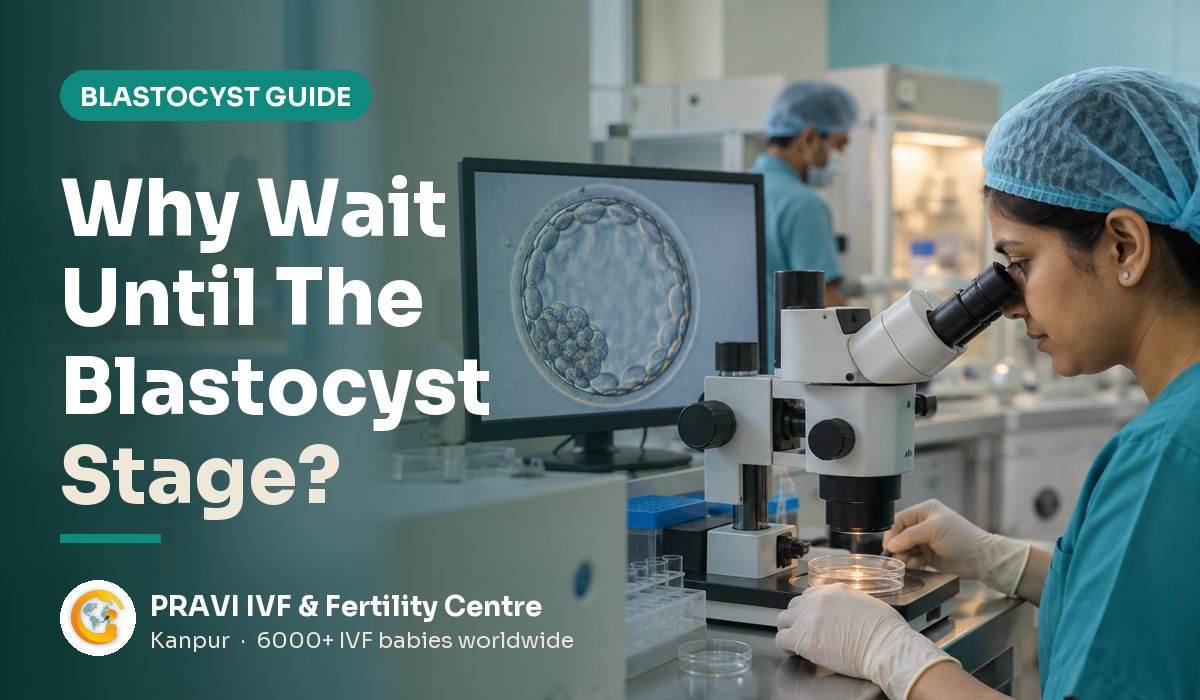
Blastocyst Transfer in Kanpur
Medically reviewed by Dr. Rit Shukla · Updated 12 Oct 2026
Learn how blastocyst transfer in Kanpur improves IVF outcomes by letting embryos grow to Day 5 in an advanced laboratory before implantation.
When you start an IVF journey, every small milestone brings a mix of hope and anxiety. You wait for egg retrieval, you wait for fertilization updates, and then comes the crucial decision about when to transfer the embryo. In recent years, Blastocyst Transfer in Kanpur has become one of the most trusted steps forward for couples facing complex fertility challenges. Instead of placing embryos into the uterus on day two or day three, fertility specialists allow the embryo to develop until day five or six.
This extended culture gives the medical team a clearer view of which embryos are truly strong and capable of growing. At PRAVI IVF & Fertility Centre, we know how deeply you yearn for good news. A successful pregnancy is not just about medical protocols; it is about giving your embryo the safest start in life. By mimicking nature as closely as possible, day 5 embryo transfer gives hopeful parents in Uttar Pradesh a reliable, scientifically backed path toward holding their baby in their arms.
What Is a Blastocyst?
In natural conception, an egg is fertilized inside the fallopian tube. Over the next several days, the fertilized egg begins to divide, moving slowly toward the womb. By day five or six, it has divided into many cells and formed a special structure called a blastocyst. A blastocyst consists of two distinct cell types: the inner cell mass, which eventually becomes the fetus, and the outer layer called the trophectoderm, which forms the placenta.
In standard IVF cycles years ago, embryos were often transferred on day two or day three (known as the cleavage stage). At that point, the embryo only contains around 6 to 8 cells. While many babies have been born from day 3 transfers, it is much harder to predict which day 3 embryo has the genetic strength to continue dividing. According to patient education resources from ReproductiveFacts.org, letting embryos grow into blastocysts allows natural selection to filter out those that carry severe developmental arrests.
Only the sturdiest embryos make the transition from day 3 to day 5. When an embryo reaches the blastocyst stage in a specialized embryology lab, its chances of attaching to the uterine lining increase significantly. This makes blastocyst transfer a preferred choice for modern fertility treatments.
Why Blastocyst Transfer in Kanpur Offers Better Outcomes
For couples undergoing IVF in Kanpur, choosing a blastocyst transfer brings several clear advantages. In nature, a day 3 embryo would still be inside the fallopian tube, not the uterus. The lining of the uterus becomes receptive to an embryo around day 19 to 21 of a typical menstrual cycle, which matches the timing of a day 5 blastocyst. Transferring at this stage ensures natural uterine harmony.
Another major benefit is the ability to transfer fewer embryos while maintaining high success rates. In the past, doctors often transferred three or four day 3 embryos to improve the odds of at least one sticking. Sadly, this frequently led to high-risk multiple pregnancies, such as triplets or twins, which carry health risks for both mother and babies. As highlighted by the NHS guide to IVF treatment, single embryo transfer at the blastocyst stage reduces the danger of multiple births while maintaining strong implantation chances.
By selecting a single genuine-quality blastocyst, our team helps protect the mother's health and ensures the growing baby has the genuine environment to thrive throughout pregnancy.
Cleavage Stage (Day 3) vs. Blastocyst (Day 5) Transfer
To help you understand the core differences between these two transfer strategies, review the comparison below:
| Feature | Day 3 Transfer (Cleavage Stage) | Day 5 Transfer (Blastocyst Stage) |
|---|---|---|
| Embryo Size | 6 to 8 cells | Over 100 to 150 complex cells |
| Natural Location | Normally in the fallopian tube | Naturally enters the uterine cavity |
| Selection Accuracy | Moderate (harder to predict viability) | High (filters out weak embryos) |
| Number Transferred | Often 2 to 3 embryos | Usually 1 (or at most 2) blastocysts |
| Risk of Multiple Births | Higher if multiple embryos implant | Lower due to single blastocyst transfer |
| Suitability for PGT-A | Limited and rarely performed | Optimal stage for safe genetic biopsy |
While day 3 transfers still have a role for patients with very few eggs, day 5 transfer remains the preferred standard for most couples who want the clearest path to success.
The Advanced Embryology Lab Behind Every Blastocyst
A blastocyst cannot grow without an exceptional laboratory environment. Developing embryos are very delicate. They are sensitive to tiny changes in temperature, air purity, light, and humidity. Growing an embryo outside the human body for five full days requires specialized culture media that change nutrients as the embryo grows.
At PRAVI IVF, our embryology lab is led by Dr. Rit Shukla, Chief Embryologist, who brings over a decade of dedicated expertise in reproductive biology. Dr. Shukla and our laboratory team use benchtop incubators that maintain ideal gas mixtures and stable temperatures. This warm, protective setup acts just like the natural environment of a mother's reproductive tract.
If a clinic lacks high-end incubators or air filtration units, embryos can stop growing before day 5, even if they had normal potential. That is why choosing a clinic with a proven lab and an experienced embryologist is the most vital decision you make during an IVF cycle.
Who Benefits Most from Blastocyst Transfer?
While almost every IVF patient can benefit from blastocyst culture, certain clinical situations make it especially valuable:
- Couples with Previous IVF Failures: If you have experienced failed cycles with day 3 embryos at another centre, cultivating to day 5 can reveal whether embryo development stops midway.
- Couples Seeking Single Embryo Transfer (eSET): If a woman has medical conditions where carrying twins could be dangerous, a single blastocyst offers the safest approach.
- Patients Opting for PGT-A: Preimplantation Genetic Testing requires taking a few cells from the outer layer (trophectoderm) of a blastocyst without harming the cells that form the baby.
- Unexplained Infertility: Extended culture can provide useful diagnostic answers regarding how your eggs and sperm interact and grow over time.
- Cases of Severe Male Factor: When sperm parameters are low, or after surgical sperm retrieval like Micro-TESE for Azoospermia in Kanpur, blastocyst culture confirms that fertilization produced viable embryos.
How Embryos Are Graded on Day 5
Patients often ask what their blastocyst grade means when they receive their lab report. Blastocysts are graded using established medical systems, such as the Gardner grading system, based on three main factors:
First, the degree of expansion is scored from 1 to 6. A score of 1 means an early blastocyst, while a 5 or 6 means the blastocyst is fully expanded or hatching out of its protective shell (zona pellucida), ready to implant. Second, the inner cell mass (the future baby) is given a letter grade: A, B, or C, where A represents tightly packed, healthy cells. Third, the trophectoderm (the future placenta) is also graded A, B, or C based on the number and health of surrounding cells.
A blastocyst graded as 4AA or 4AB is considered genuine quality. Even blastocysts with grades like 3BB or 4BB have strong potential to result in healthy babies. Our embryology team explains every detail of your embryo report in simple words so you feel informed and confident.
Fresh vs. Frozen Blastocyst Transfer
Once your embryos reach the blastocyst stage, your fertility doctor will decide whether a fresh transfer or a frozen embryo transfer (FET) is the genuine choice for your body. According to clinical guidance from the Mayo Clinic IVF overview, frozen transfers have become very popular because they give the woman's ovaries time to rest after hormonal stimulation.
During an egg retrieval cycle, hormone levels can be very high. This can sometimes make the uterine lining less receptive, or increase the risk of Ovarian Hyperstimulation Syndrome (OHSS). In such cases, vitrification (rapid freezing) is performed on day 5. The blastocysts are safely stored in liquid nitrogen. A month or two later, the uterus is gently prepared with natural or mild hormonal protocols, and the thawed blastocyst is placed inside when the body is calm and ready.
Frozen blastocyst transfers consistently deliver a high success rate while keeping the mother comfortable and safe from complications.
Step-by-Step: What to Expect During the Transfer Procedure
The day of your blastocyst transfer is an emotional and special moment. Many patients feel nervous, wondering if the procedure will hurt. Fortunately, an embryo transfer is very gentle, quick, and does not require general anaesthesia.
You will be asked to arrive at our clinic with a comfortably full bladder. A full bladder straightens the angle of the uterus and helps the doctor view the catheter clearly on an abdominal ultrasound screen. You will lie comfortably on the examination couch. The doctor cleans the cervix gently with warm saline.
Under direct ultrasound visualization, the doctor passes a soft, flexible catheter through the cervix into the uterine cavity. The embryologist carefully loads the chosen blastocyst into the catheter. With steady precision, the embryo is released into the middle of the womb with a tiny drop of fluid. The catheter is then checked under a microscope to confirm that the embryo was successfully placed. The whole process takes only 10 to 15 minutes, after which you rest briefly before heading home.
What Happens After the Transfer: The Two-Week Wait
The days following your transfer can test your patience. Many couples wonder what they should do to help the embryo stick. We remind our patients that a blastocyst usually begins implanting within 24 to 48 hours after the procedure.
You do not need strict bed rest. In fact, gentle walking promotes healthy blood flow to your pelvis. Avoid heavy lifting, intense workouts, and hot tubs. Continue taking all progesterone and hormonal medications exactly as prescribed by your doctor. Light cramping or minor spotting can happen and is often a normal sign of implantation, so try not to worry. After 12 to 14 days, a blood test measuring Beta hCG will confirm whether pregnancy has occurred.
Understanding the Cost Factors in Kanpur
Cost is an understandable concern for every family planning fertility care. The cost of a blastocyst transfer depends on several medical factors rather than a single fixed rate. Key factors include whether you are doing a fresh or frozen transfer, the need for extended lab culture media, embryo freezing charges, and whether advanced tests like PGT-A or ICSI are required.
At PRAVI IVF, we believe in complete financial transparency. We do not believe in hidden fees or unexpected bills. During your initial consultation, our financial counsellors discuss all components of your treatment plan and provide a clear, written estimate so you can plan your journey without financial surprises.
Accessible Fertility Care Across Kanpur and Surrounding Cities
Patients travel from across the region to access our dedicated embryology laboratory and experienced clinical team. Whether you are searching for a Fertility Centre near Shyam Nagar, Kanpur, seeking care at our Fertility Clinic near Pandu Nagar, Kanpur, or visiting us as an IVF Centre near Fatehpur: Kanpur Clinic Guide, our clinics are conveniently situated to serve you.
Our main Kanpur centres are located at Swaroop Nagar and Shardha Nagar. Both locations provide full diagnostics, hormone assessments, follicular monitoring, and personalized clinical consultations under one roof, saving you stressful commutes during your treatment cycle.
Meet the Medical Experts Guiding Your Care
Your fertility journey requires both medical science and deep empathy. Our team at PRAVI IVF is led by highly accomplished reproductive specialists who treat every patient with warmth and honesty:
- Dr. Monica Sachdeva: Medical Director with over 18 years of experience in IVF and reproductive medicine, known for her personalized patient protocols.
- Dr. Rit Shukla: Chief Embryologist with over 10 years of laboratory leadership, specializing in blastocyst culture, vitrification, and micromanipulation.
- Dr. Sakshi Tandon: Renowned gynaecologist and fertility specialist dedicated to gentle patient care and thorough diagnostic evaluations.
- Dr. Ankita: Specialist holding MRCOG, a Fellowship in Reproductive Medicine, and a Diploma in Minimal Access Surgery, bringing over 6 years of focused clinical expertise.
Together, our clinical and laboratory teams ensure that every embryo receives the highest standard of scientific care, giving your family the genuine opportunity to grow.
Every familyâs path to parenthood is unique, and experiencing setbacks along the way can feel overwhelming. If you are ready to explore advanced embryo care, reach out to our team at PRAVI IVF & Fertility Centre. We invite you to book an appointment or visit our contact page to discuss your options and take the next confident step toward your dream of holding your baby.
Frequently asked questions
What is the main difference between a day 3 and day 5 embryo transfer?
A day 3 embryo contains 6 to 8 cells, whereas a day 5 blastocyst has grown to more than 100 cells with differentiated structures. Culturing to day 5 allows embryologists to select the healthiest embryos that have shown true growth potential.
Does a blastocyst transfer guarantee pregnancy?
No medical procedure can guarantee pregnancy, but blastocyst transfer offers higher implantation rates compared to earlier-stage transfers. Success depends on embryo quality, uterine receptivity, maternal age, and underlying health factors.
Can all embryos survive until day 5 in the laboratory?
Not all embryos make it to day 5. On average, about 40 to 50 percent of fertilized eggs progress to the blastocyst stage. This natural drop-off is normal and helps identify which embryos are genetically competent.
Is the blastocyst transfer procedure painful?
No, the transfer procedure is quick and generally painless, feeling very similar to a standard routine pelvic exam or Pap smear. It does not require sedation or anaesthesia, and you can return home shortly after it is finished.
How many blastocysts are typically transferred at one time?
In most cases, doctors recommend transferring a single blastocyst to achieve a healthy pregnancy while avoiding the complications of multiple births. In specific clinical cases, your doctor may consider transferring two blastocysts after discussing the risks.
Why might my doctor suggest freezing my blastocysts instead of a fresh transfer?
Freezing blastocysts allows your hormones to settle after ovarian stimulation, giving the uterine lining time to prepare naturally in a subsequent cycle. This approach reduces the risk of OHSS and often creates a more receptive environment for implantation.
What should I avoid doing right after my blastocyst transfer?
Avoid intense physical workouts, heavy lifting, swimming, hot baths, and smoking or alcohol. You do not need complete bed rest, but keeping your routine relaxed and taking your prescribed medications on time is essential.
When can I take a pregnancy test after a blastocyst transfer?
A blood Beta hCG test is typically scheduled 12 to 14 days after your transfer. Testing at home too early with urine strips can yield false negatives or false positives due to medications used during treatment.