
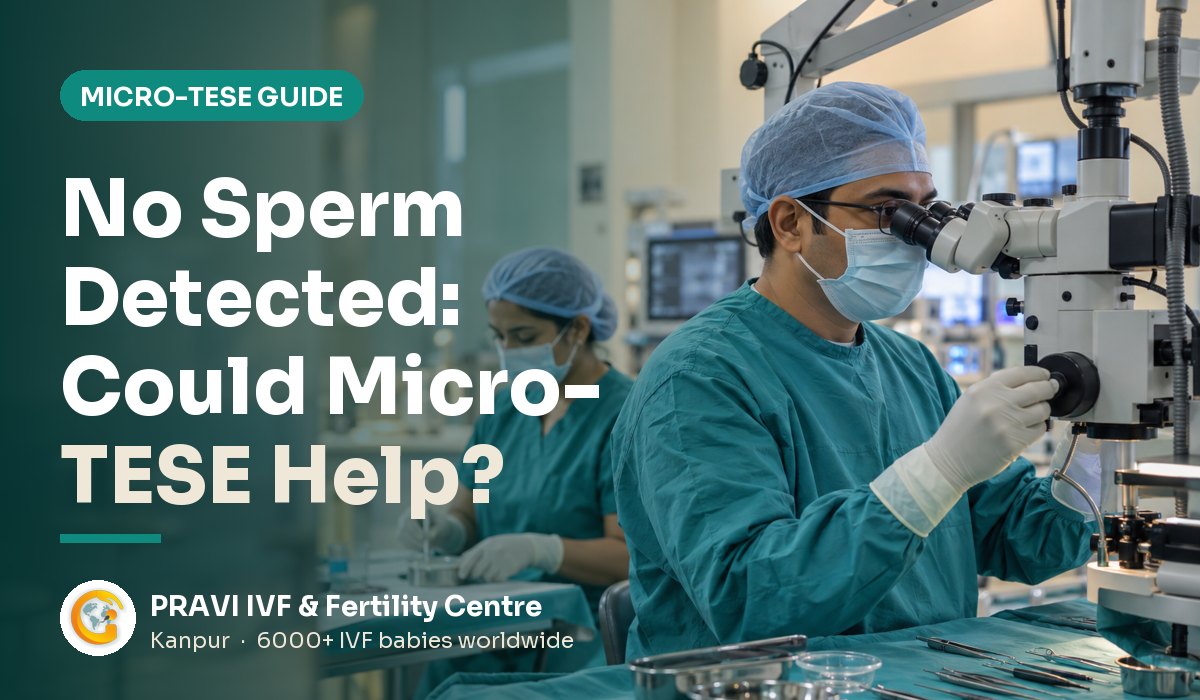
Micro-TESE for Azoospermia in Kanpur
Medically reviewed by Dr. Monica Sachdeva · Updated 5 Oct 2026
A diagnosis of zero sperm count does not mean your journey to fatherhood is over. Learn how Micro-TESE in Kanpur helps men with non-obstructive azoospermia retrieve viable sperm.
Hearing the words “zero sperm count” can feel like a heavy blow. When a routine semen report shows azoospermia, many men feel shock, confusion, and deep heartbreak. In our society, men rarely talk about reproductive health openly. Most suffer in silence, worrying that their dream of having a biological child has ended before it even began.
At PRAVI IVF & Fertility Centre in Kanpur, we want you to know one vital truth: zero sperm in your semen does not automatically mean zero sperm in your body. Thanks to advanced surgical innovations like Micro-TESE, many men with severe male factor infertility can still father their own genetic children. With patience and proper medical guidance, there is real umeed (hope).
Understanding Azoospermia: Why Semen May Show Zero Sperm
Azoospermia means that no sperm cells are visible under a microscope during a standard semen analysis. According to global health data from the World Health Organization, male factor challenges contribute to nearly half of all infertility cases. It is far more common than people think.
Doctors divide azoospermia into two main categories:
- Obstructive Azoospermia (OA): In this condition, your testicles produce healthy sperm, but a blockage or missing duct prevents them from mixing into the semen. Men with OA often have straightforward solutions through needle aspiration techniques like TESA and PESA in Kanpur.
- Non-Obstructive Azoospermia (NOA): In this condition, there is no physical blockage. Instead, the testicles struggle to produce sperm in regular amounts. Production may be severely impaired, scattered, or limited to tiny microscopic pockets inside the testicular tissue.
For men diagnosed with Non-Obstructive Azoospermia, standard needle aspirations often come back empty. This is where Micro-TESE for Azoospermia in Kanpur offers a life-changing breakthrough.
What is Micro-TESE?
Micro-TESE stands for Microsurgical Testicular Sperm Extraction. It is an advanced, highly focused surgical procedure designed specifically for men with non-obstructive azoospermia. Unlike blind biopsies or simple needle pricks, Micro-TESE uses a specialized operating microscope that magnifies testicular tissue up to 20 to 25 times.
Human testicles contain hundreds of tiny thread-like loops called seminiferous tubules. In men with NOA, most tubules are collapsed or empty. However, isolated “islands” of active tubules may still produce healthy sperm cells. Because these tiny active tubules are slightly thicker and opaque, an experienced surgeon can spot them under powerful magnification.
The operating surgeon carefully opens the scrotum and examines the tissue under the microscope. By identifying and sampling only the most promising tubules, the surgeon protects healthy blood vessels and avoids unnecessary tissue loss. This precision makes Micro-TESE the gold standard worldwide for severe male infertility.
Micro-TESE vs Traditional Sperm Retrieval Methods
Many patients ask why simple needle procedures like TESA or conventional open biopsies are not enough for non-obstructive cases. A blind biopsy removes tissue randomly, which can damage testicular blood supply while completely missing isolated pockets of sperm.
The table below highlights the practical differences between conventional retrieval and Micro-TESE:
| Feature | Conventional TESA / TESE | Micro-TESE |
|---|---|---|
| Magnification Used | None (Blind or naked eye) | High-power surgical microscope (20x–25x) |
| Tissue Removal | Random or larger tissue chunks | Microscopic, pinpoint tissue selection |
| Vascular Safety | Higher risk to delicate blood vessels | Excellent preservation of blood supply |
| Primary Indication | Obstructive Azoospermia | Non-Obstructive Azoospermia (NOA) |
| Post-Op Recovery | Quick, but lower yield in NOA | Mild soreness, minimal tissue disruption |
Micro-TESE provides a significantly higher likelihood of finding usable sperm in NOA cases compared to standard methods. It also minimizes long-term drops in testosterone production by preserving non-sperm-producing Leydig cells.
The Micro-TESE Journey at PRAVI IVF Kanpur
Under the clinical leadership of Dr. Monica Sachdeva, our team approaches male infertility with deep clinical rigor and empathy. We follow clear, evidence-based steps to ensure you feel supported at every stage.
1. Thorough Pre-Surgical Evaluation
Before planning any surgical procedure, we run careful diagnostic checks. These include detailed hormone panels (such as FSH, LH, and Testosterone), high-resolution scrotal Doppler ultrasound, and genetic screenings like karyotyping and Y-chromosome microdeletion testing. Understanding the root cause ensures we do not perform surgery if there is a known genetic reason where sperm cannot form.
2. Optimizing Testicular Function
In select patients, medical therapy over three to six months can help prime the testicles before surgery. Balancing hormones can give sluggish tubules a better environment to produce sperm before the microsurgical procedure takes place.
3. The Day of Surgery
Micro-TESE is performed as a day-care procedure under general or regional anaesthesia, meaning you will feel no pain during the surgery. The surgeon makes a small incision and uses the microscope to meticulously scan both testicles if necessary. Most men return home on the same day with simple pain relievers and supportive scrotal dressings.
4. Real-Time Laboratory Coordination
At PRAVI IVF, our surgical team works hand-in-hand with our embryology team, led by Chief Embryologist Dr. Rit Shukla. As tiny tissue samples are retrieved, they are immediately brought to our cleanroom embryology lab. The tissue is mechanically teased apart and examined under an inverted microscope right away. If viable sperm are located, they can be used fresh for Intracytoplasmic Sperm Injection (ICSI) or frozen for future cycles.
To understand how retrieved sperm is combined with your partner's eggs, you can read our detailed guide on the IVF process step by step in Kanpur.
Who Can Benefit from Micro-TESE?
Micro-TESE is specifically designed for men who have had multiple semen analyses confirming zero sperm, alongside indicators of non-obstructive azoospermia. You might be a strong candidate if you have:
- Elevated Follicle-Stimulating Hormone (FSH) levels with normal or slightly reduced testicular volume.
- A history of undescended testicles (cryptorchidism) corrected later in childhood.
- Previous mumps infection that affected the testicles (mumps orchitis).
- Prior exposure to chemotherapy or radiation during early life.
- Unexplained or idiopathic testicular failure.
- A previous failed conventional needle biopsy (TESA) that showed no sperm.
Couples travel to our Swaroop Nagar and Shardha Nagar clinics from across Kanpur Nagar, as well as nearby districts. We regularly provide advanced male fertility care as an IVF centre for Farrukhabad couples in Kanpur, as well as families visiting from Unnao, Fatehpur, and Etawah.
Overcoming Myths Around Male Infertility
In many parts of Uttar Pradesh, infertility is still wrongly assumed to be an exclusively female issue. When a couple struggles to conceive, the wife often undergoes multiple tests and treatments while the husband delays even a basic semen test. This delay costs valuable reproductive years.
Another common misconception is that zero sperm means you are unmanly or incapable of fatherhood. Virility, libido, and erection are driven by testosterone, whereas sperm production is a microscopic cellular process. A man can feel completely healthy, strong, and active while having non-obstructive azoospermia. You can learn more about clearing these societal misunderstandings in our resource on IVF myths vs facts.
Reproductive medicine has advanced rapidly. Guidelines supported by the American Society for Reproductive Medicine (ASRM) and Indian clinical bodies recognize that surgical sperm retrieval combined with ICSI allows men with NOA to achieve biological fatherhood safely.
What Influences Micro-TESE Success?
We believe in honest, transparent medical communication. Micro-TESE has a high success rate for finding sperm even when needle biopsies have failed, but success depends on individual biological factors. Key elements that influence outcomes include:
- Testicular Histopathology: Men with conditions like hypospermatogenesis or late maturation arrest generally have higher retrieval chances than men with complete Sertoli cell-only syndrome (SCOS).
- Genetics: Men with AZFc microdeletions on the Y chromosome often have viable sperm retrieved, whereas deletions in AZFa or AZFb regions generally have poor prognosis.
- Microscope Quality & Surgeon Skill: Microsurgery requires high-end optical equipment and patient, skilled hands. Finding tiny focal points of spermatogenesis can take two to three hours of dedicated microscopic searching.
- Embryology Expertise: Once the tissue reaches the lab, an experienced embryologist must patiently search through the fluid to isolate living sperm cells, even if only a few dozen exist.
All clinical and lab procedures at PRAVI IVF are conducted strictly within the ethical and safety guidelines laid down by the Indian Council of Medical Research (ICMR).
Understanding the Cost of Micro-TESE in Kanpur
Patients naturally want to understand the financial investment before starting treatment. Because Micro-TESE requires an advanced surgical operating microscope, specialized microsurgical instruments, a trained microsurgeon, and hours of intensive embryology work, it involves different expenses than a standard office biopsy.
Cost factors include:
- Pre-operative blood tests, hormonal profiles, and genetic mapping.
- Operating theatre charges, specialized microscope utilization, and anaesthesia fees.
- Surgeon and microsurgical team charges.
- Embryology processing, sperm isolation, and sperm cryopreservation (freezing).
- The accompanying ICSI and IVF cycle for your partner.
At PRAVI IVF, we do not believe in hidden fees or surprise billing. After your initial evaluation and scrotal assessment, our team provides a clear, itemized written estimate so you can make informed decisions with complete financial peace of mind.
Why Choose PRAVI IVF for Male Infertility Care?
PRAVI IVF & Fertility Centre brings together experienced reproductive specialists, including Medical Director Dr. Monica Sachdeva, gynaecologist and fertility specialist Dr. Sakshi Tandon, and Dr. Ankita (MRCOG, Fellowship in Reproductive Medicine). Together with Chief Embryologist Dr. Rit Shukla, our team ensures seamless coordination between the surgical theatre and the embryology laboratory.
We treat every patient with dignity, privacy, and clinical dedication. Whether you are dealing with a fresh azoospermia report or have faced failed treatments elsewhere, our clinics in Swaroop Nagar and Shardha Nagar are equipped to guide you forward.
A diagnosis of zero sperm count can feel overwhelming, but you do not have to navigate this path alone. To explore whether Micro-TESE is right for you, book an online appointment or reach out through our contact page to speak with our compassionate fertility team in Kanpur today.
Frequently asked questions
What is the recovery time after a Micro-TESE procedure?
Most men recover quickly after Micro-TESE. You can usually walk and return home the same day. We recommend resting for two to three days and avoiding strenuous exercise, heavy lifting, or sexual activity for about two weeks.
Is Micro-TESE painful?
The surgery itself is completely painless because it is performed under general or regional anaesthesia. After the anaesthesia wears off, you may experience mild dull aching or swelling in the scrotum for a few days, which is well controlled with standard oral pain medications.
What happens if sperm are found during Micro-TESE?
When our embryology team identifies viable sperm, the cells can be used immediately to fertilize your partner's eggs via ICSI if her egg retrieval is scheduled on the same day. Alternatively, the retrieved sperm can be cryopreserved (frozen) for use in an upcoming IVF cycle.
Can Micro-TESE be done if my previous needle biopsy (TESA) failed?
Yes, absolutely. A routine needle biopsy (TESA) is a blind aspiration that only samples a tiny fraction of the testicle. Micro-TESE allows the surgeon to inspect the entire tissue structure under 20x to 25x magnification, making it possible to locate isolated sperm pockets that a needle prick missed.
Does Micro-TESE affect future testosterone levels or sex drive?
Because Micro-TESE removes only tiny, carefully selected tubules and preserves major blood vessels, it minimizes damage to testosterone-producing Leydig cells. In rare cases, a temporary dip in testosterone occurs, but levels typically stabilize over the following months.
How long does a Micro-TESE surgery take?
A Micro-TESE procedure typically takes between one and a half to three hours. The duration depends on how quickly the surgeon and embryologist identify viable seminiferous tubules containing mature sperm.
What tests are required before undergoing Micro-TESE in Kanpur?
Before surgery, we evaluate your complete medical history and perform repeat semen analyses with centrifugation. We also conduct blood tests for FSH, LH, and Testosterone, a scrotal Doppler ultrasound, and genetic screenings such as karyotype and Y-chromosome microdeletion testing.
What if no sperm are found during Micro-TESE?
If no viable sperm can be located despite exhaustive microscopic exploration, our specialists will discuss alternative family-building options with you and your partner. These may include donor sperm programmes or surrogacy guidance, fully compliant with Indian ART laws.