0% interest EMI options · Clear treatment costs explained before you begin · Book consultation

Egg & embryo freezing treatment at PRAVI IVF
Understanding what egg and embryo freezing can—and cannot—preserve for the future.

Egg & embryo freezing in Kanpur

Egg and embryo freezing can preserve reproductive material for possible use later, but neither can guarantee a future pregnancy. The choice depends on your health, reproductive plans, whether you want to use sperm now, and the time available before other treatment. At a PRAVI IVF consultation in Kanpur, you can discuss these differences, the assessments involved, and which preservation pathway and storage arrangements are available for your circumstances.

  • Vitrification is a rapid freezing method used to preserve suitable eggs and embryos.
  • Egg freezing stores unfertilised eggs; embryo freezing requires fertilisation before storage.
  • Some eggs or embryos may not survive warming, and storage does not guarantee pregnancy.

Who this is for

  • People considering delaying pregnancy who want to understand the possibilities and limitations of storing eggs.
  • People facing chemotherapy, radiotherapy or another treatment that may affect fertility.
  • People undergoing IVF who may have suitable embryos to store for a later transfer.
  • People with certain ovarian conditions or planned ovarian surgery who need individual fertility-preservation advice.
  • People deciding between storing unfertilised eggs and creating embryos with a legally permitted sperm source.

Why patients choose PRAVI

High

IVF success rate

6,000+

Babies delivered

4.9/5

600+ patient reviews

18+

Years of fertility care

Mon – Sat · 9:00 AM – 7:00 PM

Step by step

How the Egg & embryo freezing process works

01

Discuss your reasons and timing

Review your reproductive plans, medical history and any upcoming treatment with a fertility specialist. Discuss whether egg freezing, embryo freezing or another approach is appropriate, and confirm the available pathway before making a decision.

02

Assess likely ovarian response

Ultrasound and selected blood tests help assess ovarian reserve and plan stimulation. Results estimate likely egg yield rather than egg quality, and the clinician explains relevant health checks, treatment timing and practical preparation.

03

Stimulate the ovaries and collect eggs

Fertility medicines encourage several follicles to develop, with monitoring to guide treatment. Eggs are collected through an ultrasound-guided procedure under sedation or anaesthesia; the exact approach and safety arrangements are discussed beforehand.

04

Freeze eggs or create embryos

Suitable mature eggs may be frozen directly, or eggs may be fertilised with an agreed sperm source before suitable embryos are frozen. Laboratory development varies, and not every collected egg reaches the intended storage stage.

05

Arrange storage and future review

Before storage, review consent, identification procedures, permitted storage duration and future-use arrangements. When you are ready, a fresh medical assessment helps determine whether warming eggs or embryos and attempting treatment remains suitable and lawful.

Choosing between freezing eggs and freezing embryos

Egg freezing stores unfertilised eggs for a possible future attempt at pregnancy. Embryo freezing stores embryos created by fertilising eggs with sperm in the laboratory. Both commonly use vitrification, a rapid cooling process designed to limit ice-crystal formation, followed by storage at very low temperatures. The practical difference is when decisions about sperm and fertilisation are made. Freezing eggs allows those decisions to be deferred; creating embryos requires an agreed, legally permitted sperm source and appropriate consent before fertilisation.

Neither option pauses every aspect of reproductive ageing or provides insurance against infertility. The age at which eggs are collected influences their reproductive potential, while health and age at a future pregnancy still affect pregnancy-related risks. Embryos provide information about fertilisation and early development, but their appearance cannot establish that they will implant or lead to a healthy birth. Ask which option fits your circumstances without assuming one is always preferable.

When fertility preservation may be worth discussing

People consider freezing for different reasons: delaying parenthood, preparing for treatment that could damage ovarian function, or storing suitable embryos during IVF. Advice may also be relevant before some ovarian operations or when a condition could reduce the remaining egg supply. If chemotherapy or another time-sensitive treatment is planned, early communication between the fertility specialist and treating team is important. Preservation must be considered alongside the urgency and safety of treating the underlying illness, not as an automatic reason to delay care.

Freezing may not be suitable when ovarian stimulation or egg collection presents unacceptable medical risk, there is insufficient time, or the expected chance of obtaining usable eggs is very limited. It may also be unnecessary for someone ready to attempt pregnancy now, depending on their assessment. A low ovarian reserve result needs individual interpretation rather than an automatic refusal or promise. Counselling should leave room for proceeding, postponing, considering alternatives or deciding not to freeze.

What the assessment can tell you about egg yield

Assessment usually begins with menstrual history, previous pregnancies or fertility treatment, medicines, operations and relevant family history. An ultrasound may assess the ovaries and count visible small follicles. Blood tests can include anti-Müllerian hormone, or AMH, and other hormones where appropriate. AMH helps estimate egg quantity and likely response to stimulation; it does not measure egg quality or establish whether natural pregnancy will occur. Different hormone tests have different timing requirements, so ask when each sample should be taken.

The clinician also considers whether sedation or anaesthesia is suitable and which infection screening or other investigations are needed. If embryos are planned, the sperm source and any required semen assessment should be discussed early. Results help set expectations, but they cannot predict the exact number of mature eggs, embryos or future births. Ask how your findings affect the options, whether further specialist advice is needed, and how an unexpectedly low or high response would be handled.

Preparing for appointments, medicines and decisions

Preparation includes understanding the expected appointment pattern, learning how prescribed injections are used, and arranging practical support around egg collection. Bring records of previous treatment and a complete medicine and supplement list. Do not stop prescribed medicines without advice. Ask about activity, intercourse, travel and work during stimulation because enlarged ovaries can cause discomfort and may require temporary precautions. Before collection, follow the team's fasting instructions and arrange an escort if sedation or anaesthesia is planned.

Consent should cover more than the freezing procedure. You should understand what will be stored, how identity and traceability are maintained, and what decisions may arise later. Embryo storage can involve ongoing consent from the relevant parties, making discussions about separation, withdrawal of consent or death particularly important. Storage and future use must follow applicable Indian law, including the ART Act and current Rules. Ask for written explanations rather than relying on assumptions about indefinite storage or unrestricted future use.

  • Clarify storage duration, contact updates and renewal responsibilities.
  • Ask how consent changes and unused material are handled.
  • Confirm whom to contact if your medical treatment schedule changes.

From ovarian stimulation to laboratory freezing

During a typical cycle, prescribed hormonal medicines encourage several follicles to grow. Ultrasound monitoring, sometimes supported by blood tests, guides adjustments and the timing of a final maturation injection. Egg collection usually involves an ultrasound-guided needle passed through the vaginal wall to reach the follicles, with sedation or anaesthesia. Not every follicle contains an egg, and not every retrieved egg is mature or suitable for freezing. The team should explain these possible losses before treatment begins.

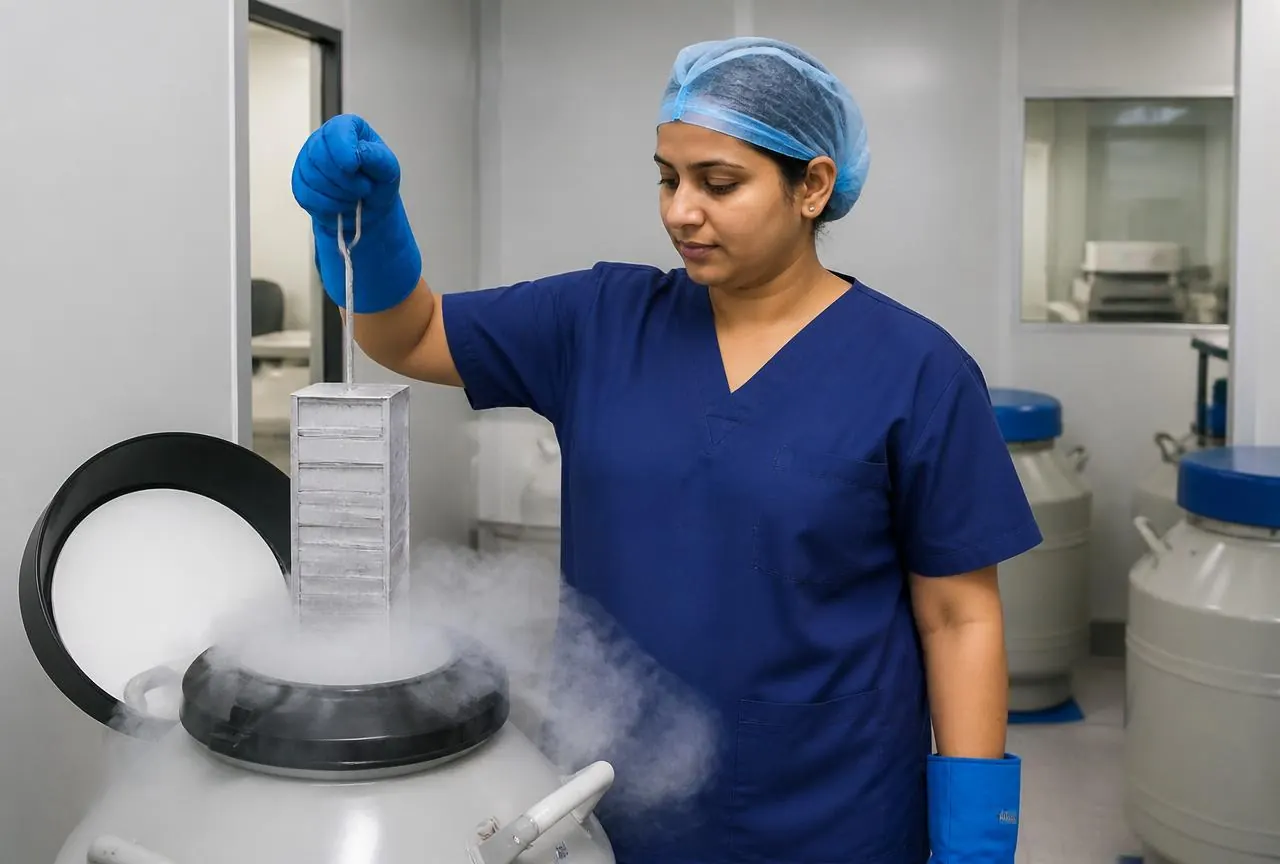
For egg freezing, suitable mature eggs are prepared with protective solutions, vitrified and stored. For embryo freezing, eggs first undergo IVF or ICSI, followed by laboratory observation before suitable embryos are selected for storage. ICSI injects a sperm into an egg but is not routinely better for every IVF situation. Fertilisation does not guarantee continued development, implantation or live birth. Ask which method is proposed, why it is appropriate, and when you will receive the final storage record.

Understanding treatment risks and preservation limits

Stimulation can cause bloating, pelvic discomfort, headaches or mood changes. Ovarian hyperstimulation syndrome can sometimes become serious, particularly when fluid shifts cause marked swelling or breathing difficulty. Egg collection carries risks including bleeding, infection, injury to nearby structures and complications from sedation or anaesthesia. Ovarian torsion, where an enlarged ovary twists, is another possible complication. Individual risk depends on your health and response, and treatment may need modification or cancellation if safety concerns arise.

There are also limitations after an uncomplicated collection. Some eggs or embryos may not survive freezing and warming; surviving eggs may not fertilise, and embryos may stop developing or fail to implant. Preservation does not promise unchanged quality, a particular number of future attempts or a baby. Occasionally nothing suitable is available to store. Storage also depends on reliable systems, with residual risks that should be discussed. Ask how the facility identifies samples, maintains traceability and manages storage incidents.

  • Request an explanation of your individual stimulation and collection risks.
  • Ask what happens if no suitable eggs or embryos are stored.
  • Clarify the actual storage safeguards without assuming any particular witnessing technology.

Recovery now and treatment when you return

After collection, temporary cramping, light spotting and bloating can occur. Discharge depends on clinical assessment rather than a guaranteed timetable. Follow the team's advice on rest, medicines and returning to usual activities, and do not drive while affected by sedation. Seek urgent medical attention for severe or worsening abdominal pain, heavy bleeding, fever, fainting, breathlessness, reduced urination or rapidly increasing swelling. Confirm how to obtain help after leaving and whether a review is needed before resuming other medical treatment.

When you return to use stored material, your health, consent and legal circumstances need reassessment. Frozen eggs are warmed and surviving eggs usually undergo ICSI before embryos are considered for transfer. Frozen embryos are warmed for transfer after the uterine lining is prepared or appropriately timed within a natural cycle. Not everything stored must necessarily be warmed together; planning is individual. After transfer, pregnancy testing and subsequent follow-up establish the result, since symptoms alone cannot confirm pregnancy.

Questions to bring to a PRAVI IVF consultation

A consultation at PRAVI IVF in Kanpur can help you compare preserving eggs, creating embryos or pursuing another approach. Bring available scan reports, hormone results, prior IVF records and details of any planned cancer treatment or surgery. Explain whether your main concern is treatment-related fertility loss, delaying pregnancy or retaining embryos from an IVF cycle. Ask for an assessment of what freezing might realistically offer in your situation, including the possibility that treatment produces little or no material for storage.

Confirm the exact services available, where collection, laboratory work and storage take place, and how future warming and treatment would be arranged. Ask who will explain laboratory records, consent responsibilities and changes in contact details. If donor sperm is being considered, sourcing must follow registered ART bank requirements and current law; eligibility and the lawful pathway need checking first. The discussion should support an informed choice without pressure to proceed or a promise of future pregnancy.

Frequently asked questions

This information does not replace an individual medical assessment. Treatment suitability, available services and any legal requirements must be confirmed with the clinic before you begin.

Other services