
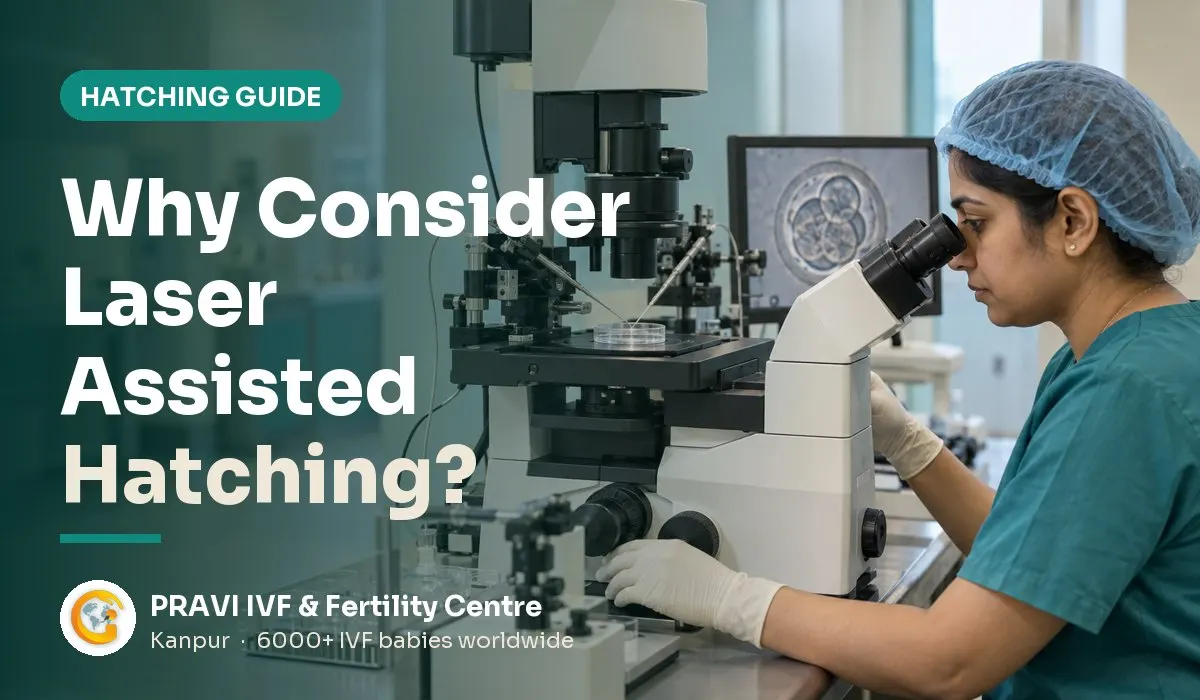
Advanced ICSI Techniques for Challenging Cases in Kanpur
Complex fertility concerns need a clear diagnosis, not simply more procedures. Learn when ICSI, sperm retrieval and selected laboratory techniques may help, and which add-ons need careful discussion.
Advanced ICSI techniques in Kanpur may help selected couples facing severe sperm problems, previous fertilisation failure or the need for surgical sperm retrieval. The right approach depends on the cause of infertility, egg and sperm factors, and earlier treatment records, not on choosing every available laboratory add-on. At PRAVI IVF & Fertility Centre, Kanpur, you can discuss which options are relevant to your situation.
What is ICSI, and when can it help?
Intracytoplasmic sperm injection, or ICSI, is a laboratory procedure used during IVF. An embryologist injects one sperm directly into a mature egg to assist fertilisation. The resulting embryos are monitored before a suitable embryo is considered for transfer or freezing.
ICSI helps overcome certain barriers to sperm entering an egg. However, it cannot correct every sperm or egg problem, guarantee normal embryo development, or ensure pregnancy.
Your specialist may consider ICSI when there is:
- A severely reduced sperm count or very poor sperm movement.
- A need to use sperm collected surgically from the reproductive tract.
- Previous failed or unexpectedly low fertilisation with conventional IVF.
- Use of previously frozen eggs after warming.
ICSI is not automatically better than conventional IVF for everyone. When semen findings are suitable and there is no previous fertilisation problem, routine ICSI may not improve the chance of having a baby. Our page on ICSI versus IVF explains this choice in simple terms.
Understanding a challenging case before choosing treatment
A difficult treatment history deserves a careful review, rather than an immediate list of extra procedures. Both partners should be assessed because fertility depends on more than a semen report.
Looking beyond one semen test
Semen findings can vary. If a result is abnormal, your doctor may recommend repeat testing and review recent fever, medicines, tobacco use, medical conditions and previous surgery. Examination and hormone tests may help identify why sperm production or transport is affected.
For some men with no sperm in the ejaculate or a very low count, genetic testing and counselling may be appropriate. Certain genetic findings can affect treatment planning and may have implications for a future child.
Reviewing earlier IVF or ICSI cycles
If you have had treatment before, bring the laboratory summary, not only the pregnancy test result. The number of mature eggs, fertilisation findings, embryo development and sperm source can help the team understand where difficulties occurred.
Egg age, ovarian response and uterine factors also matter. Repeating ICSI with a different sperm-selection method may not address the actual cause of an unsuccessful cycle.
Advanced ICSI techniques in Kanpur: which options may matter?
Surgical sperm retrieval for selected men
Azoospermia means that no sperm are found in the ejaculate. Sometimes sperm production continues but a blockage prevents sperm from reaching the semen. In other cases, sperm production itself is impaired.
Depending on the cause, sperm may be retrieved from the epididymis or testis. Procedures include PESA, TESA and testicular sperm extraction. Microdissection testicular sperm extraction, often called micro-TESE, may be considered for selected men with impaired sperm production and requires specialist expertise.
These procedures are not interchangeable, and sperm retrieval is not assured. Your doctor should explain the likely usefulness, risks, anaesthesia requirements and backup plan. Read more about TESA and PESA for sperm retrieval, and confirm which approach is appropriate and available for your case.
Finding usable sperm when very few are available
When sperm are extremely scarce or have very poor movement, careful laboratory assessment becomes especially important. A sperm that does not move is not always dead; validated viability-assessment methods may help identify living sperm for ICSI in selected situations.
The team may discuss freezing a backup sample when feasible, particularly if sperm availability is unpredictable. Ask what will happen if no usable sperm are found on the day of egg collection, so important decisions are not left until the last moment.
Additional sperm-selection methods
You may hear about PICSI, IMSI, microfluidic sperm selection or magnetic-activated cell sorting. These methods use different features to select or process sperm before ICSI.
Although there are reasons to study these techniques, evidence does not support offering them routinely to every couple to improve live birth outcomes. A sperm that looks better under magnification is not necessarily genetically normal.
If an add-on is suggested, ask which specific problem it aims to address, whether evidence applies to couples like you, and what remains uncertain. Availability alone is not a medical reason to use it.
Assisted oocyte activation after particular fertilisation problems
Occasionally, an egg does not activate normally after sperm injection. Assisted oocyte activation may be considered in carefully selected cases, such as certain sperm disorders or previous very poor fertilisation after ICSI.
It is not a routine step for all ICSI cycles. The specialist and embryologist should first review possible causes of fertilisation failure and explain the limited evidence, safety considerations and uncertainties before obtaining informed consent.
What about sperm DNA fragmentation and genetic testing?
Sperm DNA fragmentation testing is different from a routine semen analysis. It is not recommended as a standard first test for every couple. A specialist may consider it in selected circumstances, but interpretation depends on the clinical history and testing method.
An abnormal result does not automatically mean surgical sperm retrieval or an additional selection technique is needed. Reversible factors should be reviewed, and any proposed intervention should have a clear rationale.
Preimplantation genetic testing is also separate from ICSI. It may be considered when a known inherited condition or certain chromosome rearrangements create a specific concern. It is not automatically necessary because a couple needs ICSI, and it cannot identify every possible health condition.
What does the ICSI treatment journey involve?
The exact plan is individualised, but treatment usually involves these stages:
- Planning: Review of both partners, relevant tests, consent and a sperm-availability plan.
- Ovarian stimulation: Medicines and monitoring to support the development of multiple eggs.
- Egg collection and sperm preparation: Eggs are collected, and ejaculated or surgically retrieved sperm are prepared.
- ICSI and embryo culture: Suitable mature eggs are injected and checked for fertilisation and subsequent development.
- Transfer or freezing: The team advises whether to transfer an embryo or freeze suitable embryos for later use.
You can explore the basics of ICSI treatment in Kanpur before your consultation. Ask which visits both partners should attend and how to coordinate travel, work and sample collection.
Safety, realistic expectations and emotional support
ICSI is one part of IVF, so counselling should cover ovarian stimulation, egg collection and embryo transfer, as well as laboratory procedures. Potential risks include ovarian hyperstimulation, uncommon bleeding or infection after egg collection, and damage to some eggs during injection.
Some eggs may not fertilise, and some embryos may stop developing. Even a suitable-looking embryo may not implant. Transferring more embryos is not a simple solution because multiple pregnancy carries additional risks for the mother and babies.
It is understandable to feel anxious after a difficult diagnosis or an unsuccessful cycle. Neither partner is to blame. Ask for clear explanations, written instructions and counselling support when needed.
Questions to ask before agreeing to an advanced technique
- What is the main reason you recommend ICSI in our case?
- What would this additional procedure change?
- Is the evidence about fertilisation, or about having a baby?
- What are the risks, uncertainties and alternatives?
- What is our backup plan if sperm or suitable embryos are unavailable?
A thoughtful plan should explain both what treatment can do and what it cannot. The most useful approach is the one matched to your diagnosis, with transparent counselling and careful laboratory practice.
For personalised guidance at PRAVI IVF & Fertility Centre, Kanpur, book an appointment or WhatsApp +91 80091 50040. Bring your previous reports so the team can help you understand your next steps.
Frequently asked questions
Is advanced ICSI better than standard ICSI for every couple?
No. Additional procedures should address a specific clinical concern. Many sperm-selection add-ons do not have sufficient evidence to support routine use for improving live birth outcomes.
Can ICSI help when there is no sperm in the semen?
It may help if usable sperm can be retrieved surgically. The appropriate retrieval method depends on whether there is a blockage or impaired sperm production. Retrieval is not guaranteed, and specialist assessment is essential.
Does failed fertilisation mean we need assisted oocyte activation?
Not necessarily. The team should first review egg maturity, sperm factors and laboratory records. Assisted oocyte activation is considered only in selected cases after counselling about its evidence, risks and uncertainties.
Should everyone have sperm DNA fragmentation testing before ICSI?
No. It is not a routine initial test for all couples. A fertility specialist may suggest it when the clinical history makes the result relevant to treatment decisions.
What should we bring to an ICSI consultation at PRAVI IVF?
Bring semen analyses, hormone tests, scan reports, details of medicines and any previous IVF or ICSI laboratory summaries. Records of mature eggs, fertilisation and embryo development are particularly useful when reviewing an earlier cycle.